
Showing posts with label interviews. Show all posts
Showing posts with label interviews. Show all posts
Wednesday, September 05, 2012
Michael Slovis on Shooting "Breaking Bad" - Television's Most Cinematic Show


Thursday, February 09, 2012
"What More Can I Say?" Béla Tarr Discusses The Turn Horse

Over the last thirty
years, writer and director Béla Tarr has remained one of truly great masters of
cinema. And as much as it is a shame that he will retire from filmmaking, his
swan song, The Turin Horse, is an uncompromising
and wondrous work that may be his greatest achievement (read my review here).
Tarr prefers not to discuss his films, but he made his first appearance in the
United States in 17 years for the premiere of the film at the New York Film
Festival. Read the Q&A below:
Encountering the piece
of writing by longtime collaborator László Krasznahorkai
In 1985 was when I heard first time this text. [Laszlo] had
been lecturing in Budapest. We know what has happened to Nietzsche but we don’t
know what happened to the horse. That is the question that moved me. And since
1985, we tried to find the right answer for this question. And time to time, we
had discussions. And then when we finished The
Man From London, we said, “Okay. Let’s make it my last. Because we have to
answer this question.” So we started work with Laszlo, and this is our answer.
Collaboration with DP
Fred Kelemen and the use of movement
He was my student in Berlin in 1990. I was working with some
other cinematographers, but I’m a very autocratic old guy. I know the whole
movie from the first screen to the end, and I knew his sensibility. I can tell
him camera movements, I can tell him compositions, I can tell him a lot of
things but when the camera is rolling, he is watching the scene. You read his
sensibility; when you go a little bit closer or a little bit further, it’s
totally different. We know each other well…we are not talking during the shoot,
just doing. There’s no reason to talk. He knows what I like. Sometimes they can
say something, sometimes they don’t. That simple.
In response to a banal
question about “human behavior and nature.”
If I was able to say some words, I wouldn’t have made this
movie. This movie cost a lot of money. If I can tell you really by words, I
wouldn’t have told my friends to be there at 4 o’clock in the morning in cold
weather to show what we feel and how we feel. That’s the reason why I really
don’t like to speak about the movies. The movie is picture, sound, written,
humanized, and a lot of emotions, and the presence of the personalities. I
could say something about our responsibility to nature but what we put on the
table is a little bit more; it’s what you can see.
Wednesday, January 04, 2012
Nuri Bilge Ceylan on "Anatolia:" Filmmaker's Parable of Life

A staple on the art house and
festival scene, the Turkish filmmaker Nuri Bilge Ceylan has become an
international sensation since the release of his 2006 film, Climates. His latest work, Once Upon a Time in Anatolia (reviewed here), follows a group of policemen in a cold and distant land as they search
for the body of a dead man, of which the two criminals cannot remember where he
has been buried. Less procedural than meandering and existential, and certainly
in no rush to subscribe to anything resembling a classical narrative structure,
Once Upon a Time in Anatolia won the
Grand Prix and has been chosen as the official submission by Turkey for the
Foreign Language Film Oscar. When the film premiered at the New York Film
Festival in October, Mr. Ceylan spoke about some of the
influences and choices he makes in this philosophical epic. (One note: Mr.
Ceylan spoke in English, and some of his sentences did not make complete sense.
I eliminated some of his answers, and tried my best to interpret some of his
words to the best of my understanding. I apologize for any inaccuracy).
On the genesis of the
film
Actually, everything started from a real story. One of the scriptwriters
followed this story in Anatolia in the 80s, when he was doing his social
service, right in the same place; in this town. They searched for the body till
the morning, and that interested me a lot. We decided we could make a film out
of it. Of course, we changed a lot. We just kept the [premise] of the story.
All the characters are created [by us].
The film’s title
suggests a fairy tale like narrative…
I actually wanted it to be as realistic as possible, and as
historic to today. But we wanted to make the present as the past of the picture.
In this way, we tried to create a kind of pointless feeling.
Friday, December 30, 2011
A Private Window on a Nation: Asghar Farhadi Talks "A Separation"

Few films have been
more universally received than A
Separation, an Iranian drama from director Asghar Farhadi. The film won
multiple prizes at this year’s Berlin Film Festival, and has gone to play to
standing ovations at Telluride, Toronto, and here in New York on the festival
scene. It will also contend for the Oscars as the official selection by the
nation of Iran, surprisingly for a film that deals so bleakly with issues of
class, religion, and gender that plague Iranian society. Perhaps though, no one
can deny the power of Mr. Farhadi, who spoke about the reasons for making his
film back when the film played the New York Film Festival.
On deciding to make
the film and the entry point to the script.
When I started breaking the story I can’t point my finger to
what it was or how it was that got constructed in my head…I was already working
on another film [outside Iran] that I had planned for two years but one day, I
really felt I wanted to go back to Iran and do a film there, and that feeling
became stronger, and two days later I was back in Iran. The first image that
came to my mind was a man who had Alzheimer’s disease and that image was stuck
in my head that entire afternoon.
Working with his own
daughter, who plays the daughter in the family
Before starting to write this
script for the film, I was in a period of taking care of my daughter—taking her
to school and bringing her back every day. We were in very close company with
each other and would talk and discuss things, and I thought this could be
represented in my films. When I was writing my story, my daughter kept coming
back to my mind as the person who could be perfect for this role. I thought,
perhaps, this could be ideal, and easy for us to do so, because we had that
time period together. But as it turns out, it was a lot more difficult than I
planned on. When I asked the other actors to do certain things, they usually
accepted very fast. It was either they had seen my previous work, or out of
respect since I was the director. It was a lot more difficult with my daughter.
Whatever I asked her to do, she always had a why to ask. And it would drive me
crazy! But the good thing that happened was that [Peyman Moaadi], who plays the
father, was getting closer and closer to my daughter. They were bonding really
well. And he had another job, so my daughter would spend time in his office,
and they started getting closer together.
Wednesday, November 30, 2011
Revisited: Steve McQueen Discusses the Politics of the Body in "Hunger"

A complete unknown in the film a few
years ago, Steve McQueen has become an art house and festival favorite with
only two films. This week sees the release of his highly anticipated film, Shame, which stars Michael Fassbender as a sex addict in New York. The film
(reviewed at the New York Film Festival here) marks the second collaboration
between the director and actor. Their first film, Hunger, debuted in 2008 to critical raves and won
Mr. McQueen the Camera D’Or at the Cannes Film Festival for best debut feature.
Below is a piece on Mr. McQueen written during the film’s US release in March
2009. Hunger is available on DVD from the Criterion Collection, and I highly recommend it to anyone compelled about Shame.
Despite
a similar name, director Steve McQueen is not the same one who rode the
motorcycle in The Great Escape. The
Black British artist has been working in visual arts for many years, but Hunger, a devastating and brutal film
about the 1981 Irish Republican Army Hunger strikes led by Bobby Sands, is his
first feature film. Lunged over in his chair with an astute pair of glasses,
Mr. McQueen spoke sternly at the Meatpacking District Hotel where we met,
occasionally sipping on a fresh tea and taking long pauses before every answer.
Mr. McQueen explained that this was a story he needed to tell, “Young people
talk about Abu Grahib and Guantanamo but don’t even know what happened in their
own backyard 27 years ago.”
Hunger is a
mostly silent film that tells the story of the people within a prison known in
the United Kingdom as “The Maze,” where a number of IRA prisoners participated
in a series of dirty protests (no cleaning or shaving) and eventually turned
into a hunger strike. The purpose? To regain their status as political
prisoners, instead of simply regular criminals.
Sunday, November 27, 2011
(Not) Talking Movies: Michel Hazanavicius Discusses "The Artist"

It may comes as a surprise, but the front
runner for this year’s Oscars is a black and white silent movie from France
with no movie stars. However, it is an homage to the classic Hollywood era,
full of references to masterful films and featuring the glamour of the 1920s. That’s the conceit of The Artist (reviewed here), a film from French director
Michel Hazanavicius. His previous films include two spy comedies called OSS 117, which starred Jean Dujardin and Berenice Bejo, who here star as two actors who must deal with the coming of
sound as Hollywood transitions. Earlier this year at the New York Film
Festival, the director and stars, along with the producer Thomas Langmon,
discussed the bold project to bring silent film to a mainstream audience.
The origin of the
project
Michel Hazanavicius:
The first impulse was to make a silent movie, and I felt it was not something
so easy to connect with. Just talking about making this movie, people were
saying to me, “Why do you want to make a silent movie?” And the answer was,
“Well I want to” but it was not enough. So I had many options for a
script—well, maybe two options—but one of them was this one. I think it was
maybe easier for to accept to watch a silent movie if the subject is a silent
actor.
Collaborating with the
same actors
MH: They inspired
me—both of them. When I met Thomas [Langmon], he really wanted to make a movie
with me. I said, “Okay; we can make a movie together, but I want to make a
silent movie.” And he said, “Okay.” And then I said, “I want to do it with
Jean, Berenice, Guillaume, who is the cinematographer, and Ludovic, who wrote
the music composer.” And he said, “Okay.” So they really inspired the
characters and I used them in the writing and I really wrote it for them.
Producing a silent
movie
Thomas Langmon:
Well I had a lot of concerns. But I thought, maybe, yes today, with such a
gifted director and my adoration for Michel, I wanted to work with for a long
time, I thought yes. When he spoke about making a silent movie, I thought,
especially for a producer, “Silent…black and white…” well that’s really not
what’s expected…But I thought Michel could succeed in making a silent black and
white movie with this love story and if we had to chance to set it in Hollywood
to work with American actors, people who wanted a very small part, then it would
make it real and with the talent of Michel, it would then make a very good
movie.
Monday, November 21, 2011
Under the Skin: David Cronenberg and Michael Fassbender on "A Dangerous Method"

Since early masterpieces like Videodrome and The Fly to more recent hits like A History of Violence, director David Cronenberg has been getting
under people’s skin through his psychologically disturbing works of cinema. His
latest film, A Dangerous Method,
takes the subject of the psychological and the physical body directly, as it
follows the story of Carl Jung (Michael Fassbender) and Sigmund Freud (Viggo
Mortenson) and their early work, as well as patient of Jung’s, a hysterical
Russian named Sabina Spielrein (Kiera Knightly). Although it seems like a
departure for the director—a period piece that’s more talking and without any
disturbing violence—A Dangerous Method
is dealing with many of his favorite subjects. During the New York Film
Festival, Mr. Cronenberg sat down with screenwriter Christopher Hamption (Atonement) and Mr. Fassbender to discuss
the bold new project.
The gestation of the
project and its different forms
Christopher Hampton:
It was first written in the mid to late 90s, as a screenplay called Sabina for 20th Century Fox
and Julia Roberts’s company. It floundered in the way screenplays usually do,
but it seemed too good of material to not take further. I turned it into a
stage play called The Talking Cure,
which we did in London and the National Theater with Ralph Fiennes. About a
year or so later, I had a call from Mr. Cronenbeg, who said “I think it might
make a film.”
On the material
changing from the original script to the final version
CH: To start
with, the film was called Sabina
because it was mostly focused on Sabina Spielrein. But in between the original
screenplay and the stage play, it dawned on me that it couldn’t be Sabina, but
had to be Jung. So there was quite a shift on emphasis. The work that I did
with [Cronenberg] had to do with refining it and sharpening it and honing it.
On working on another
film about sexual perversion of the body
David Cronenberg:
That doesn’t sound like me—I think I’ve made a lot of comedies actually (laughs). I don’t really think about my
other movies at all, frankly. I don’t think about what I’ve done at all. When I
decide to do something I’m passionate about it, I’m only interested in
realizing that particular thing. I don’t think about if it fits in with
anything or if I’ve done it or not.
I think when I read Christopher’s
play—I’ve never seen it performed—in retrospect, I’ve always wanted to do
something about Freud and the birth of psychoanalysis. But to say that isn’t to
say anything really because it’s such vast topic full of incredible characters
that surrounded the birth of psychoanalysis, all of them really eccentric and
wonderful. What I saw in Christopher’s play was this really fantastic structure
that distilled the essence of the era and the psychoanalytic movement into
primarily five characters. That was a structure that could allow me to play
with that topic. I also have to point out that the first movie I ever made, Transfer, was about a psychiatrist and a
patient.
Thursday, September 15, 2011
"Cant Fight This Feeling Anymore:" Nicolas Winding Refn Talks Drive


“Every great movie has
five things: violence, romance, a great cast, American mythology, and a 90
minute running time.” So says Nicolas Winding Refn, the Danish director known
for his violent and meticulous films Bronson and Valhalla Rising. His
latest film, Drive, is his American
debut, and stars Ryan Gosling as a LA Driver who does movie stunts by day and
robberies by night (read the review here). Filled with a 1980s grunge sensibility smashed with a high-art European style, Mr. Winding Refn won the award for Best Director at Cannes
for his film. He spoke after a screening last night at Brooklyn Academy of
Music’s Bamcinematek. Here is a sampling of the insights he brought to his
creative process, as well as the greatest bromance ever told:
Mr. Winding Refn
almost killed Harrison Ford:
I was in LA
working on a movie with Harrison Ford called The Dying of the Light. It was a wonderful script about a CIA agent
who goes on an existentialist journey and then dies at the end. If I could do a
movie where Harrison Ford dies, I could contribute to society. I had gone to
Los Angeles to work with him. We would hang out, but then he was like he doesn’t
want to die. But then there’s no movie, Harrison! I was so angry for buying
into the illusion of Hollywood, I didn’t want to do it.
On how him and Mr.
Gosling had the worst first date ever, which led to the project:
Out of the
blue, I got a call from Ryan Gosling asking if I wanted have dinner with him. I
had never met him, so I was like why not?—if Harrison doesn’t want to die,
maybe you want to die. The only problem was I had a very high fever because I
had gotten sick on the plane. Harrison got me these anti-flu drugs that they
have in this country that helped put the fever down, but the only problem is
they made you as high as a kite. So I’m stoned out my mind and I got to meet
Ryan. That morning a script had arrived
from Universal, written by Hossein Amini called Drive, but I didn’t read it because I was so stoned. So I went to
dinner and I was the chair. I couldn’t
turn, so I was sitting in profile because I couldn’t move…This man had an aura
of an unbelievable proportion. He was very interested in how I make my films
and had seen all of them, and was very enthusiastic. I was feeling very
euphoric so halfway through I say will you please take me home. It was like a
blind date gone wrong! He said sure, I’ll drop you off. So this dinner which
hadn’t amounted to anything but “you’re great, I’m great, yea!” We’re sitting
in the car, driving along the freeway in Santa Monica, which is a very long
ride, in silence—blind date gone wrong, and no action. So we turn on the radio
and its soft rock, REO Speedwagon’s “I Can’t Fight This Feeling Anymore.” So
here I am with Ryan Gosling and “I Can’t Fight This Feeling Anymore” and you
know when you’re high you need to turn the music really, really loud. And I’m
getting into the song. I’m from the 80s, and I remember this pop ballad, so I
start singing along. And I can’t sing to save my life, and Ryan Gosling is
driving this car, not saying a single word. And guys we’re pretty weak when we’re
ill. So I’m missing my family and my kids and Harrison Ford won’t die, so I
start to cry. Tears are rolling down my cheek and it’s flowing out of me and
Ryan is just sitting in the car driving. I’m a Finnish filmmaker so I make
films based on what I like to see and ideas come to me in the strangest of
places, but right there I had an idea to do a movie. I turn to Ryan for the
first time and he’s a very good looking man, and I scream at him, since the
music is so loud, “I got it man! We’re gonna make a movie about a man who
drives around at night, in a car, listening to pop music, cause that’s his
emotional relief!” Ryan turns to me and looks at me and says, “Cool…I’m in.”
Sunday, April 03, 2011
Source Code Spoiler Q&A: Man Off the Moon

With only two films, director Duncan Jones has become a favorite in sci-fi geekdom. His first film, Moon, followed Sam Rockwell on a base on the Moon as he discovers a copy of himself. Now adapting another writer’s work, Souce Code follows the story of a soldier who must repeatedly assume the identity of a man on a train during the last eight minutes of his life while searching for the train’s bomber. Duncan Jones sat down last week for a discussion of the production and the logic behind the film. READER BEWARE: THIS INTERVIEW CONTAINS MASSIVE SPOILERS AND IS MEANT FOR READING AFTER SEEING THE FILM.
How did this project come about? After Moon it had been announced you were working on a film called Mute.
I actually tried to make Mute before Moon, and it was definitely too ambitious for a first feature film. It was definitely the right call to do Moon first. But I did have these aspirations to make Mute next, and that was one of the reasons I was able to meet up with Jake Gyllenhaal. He had seen Moon and seemed to very much like it. And I’m a huge admirer of his and really wanted to work with him. We met up to discuss what I hoped was going to be Mute. But he said, “I have this great script for you. You got to read it.” And he gave me Source Code. I went home and I read it, and I thought, I think there’s something I can do in this. I loved the pace of it. I was really interested in the science fiction conceit at the heart of it. And it seemed to do so many things. There was a romance to it; there was the opportunity to put some humor to it. In my mind, it was so different from Moon, but after the fact, I realized it’s not that different, especially with the act of being in a heavily confined space.
Could you talk about your interest in science fiction as a genre and maybe what some of your influences were?
I definitely consider myself a science fiction fan. My dad [ed. Note: Mr. Jones’ father is the rock star David Bowie] always liked me to read every evening for an hour or two a night growing up. If I was finding it difficult and hard at the time, science fiction became my favorite, and I was always reading one to another. So whether it was George Orwell’s Animal Farm, or John Wyndham’s Day of the Triffirds, or the major works of Phillip K. Dick, J. G. Ballard—those were the things I really enjoyed. That’s what started my science fiction interest. I love to take the opportunity to look at “What if” stories. Even like J. G. Ballard and look at the world very much how it is, but just tweak one thing. What is the world like this? And it just gives you a whole new perspective.
Wednesday, March 09, 2011
Interview: Apichatpong Weerasethakul Recalls His Past Filmmaking

Apichatpong Weerasethakul, who goes by “Joe” in the states, is small and a bit quiet, yet extremely friendly when it comes to discussing his movies. He has been considered one of the most prominent film directors of the last decade, and his last two films, Tropical Malady and Syndromes and a Century, appeared on numerous best-of-the-decade lists. Uncle Boonmee Who Can Recall His Past Lives, his Palm D’or winning film, cannot be described as a genre, even though if anything, it might be considered a supernatural film. But during the interview at Film Society below, Joe talks about the different aspects of his latest odyssey.
Not that many of us Americans know much about Thailand. But tell us about this part of Thailand. In other movies we’ve seen Bangkok and a little bit of the South, but this part seems quite different in many ways.
It’s the Northeast part, which is where I grew up, and it’s quite harsh. Many go to work in Bangkok or Phouket, so it’s also poor, and there’s a lot of tension.
Is it a place that’s especially known for spirits, and think more about mystical things.
It’s all over the country. It’s all over Thailand. The thing for an audience and Boonmee are the animals really, and it’s more serious.
Wednesday, October 06, 2010
NYFF Interview: Mike Leigh and Cast (Another Year)
 |
| Festival Director Richard Pena, Leslie Manville, Jim Broadbent, Ruth Sheen, Georgina Lowe, and Mike Leigh |
Since 1988’s High Hopes came to American audiences, the British filmmaker Mike Leigh has been considered one of the most dynamic curiosities in contemporary cinema. Starting with a cast and no script, developing characters’ entries lives before beginning to write one word, and, as this interview shows, condescending to members of the general press, Mr. Leigh makes films that truly touch on the entirety of human emotion, whether in its darkness or exuberance. Another Year, his latest film, finds a bit of both, which stars Jim Broadbent and Ruth Sheen as a happy married couple that play a surrogate mother and father to the people that enter their homes, most notably the talkative boundless Mary, in a career-turning performance from Leslie Manville. At the NYFF press conference, Mr. Leigh sat down with both his cast and his producer Georgina Lowe to discuss the creation of his film, if also to deride some critics about writing about him.
Leslie, Jim, and Ruth—You’ve all worked with Mike over the years, in leading roles. On Vera Drake and Happy-Go-Lucky, you had people who hadn’t been in lead roles before with Imeldas Staunton and Sally Hawkins. What has changed over the years with the working method?
Leslie Manville: I don’t think it really has changed over the years. I suppose it’s more about the time you had to make a film as opposed to the early days when Mike was making films for the BBC and Channel 4. So there’s more time now. But really the way we work together and collaborate and create the film hasn’t really changed.
Jim Broadbent: Absolutely the basic structure remains very much the same. I’d say the real only change, having done it quite a few times before. The process isn’t as much as a voyage of discovery, as it kind of was in the early days. The actual working has been very consistent.
Ruth Sheen: I think the main thing is that we’re all older.
Broadbent: I’m not older!
Sheen: The process is the same.
Broadbent: I thought you were going to say older and wiser and more depth and life and spirit…As we’re older, the filling in the back story for the characters takes a lot longer. When we were first working with Mike, I was in my 20s, and the characters were in their 20s, so it didn’t take long to fill in the years. But when you get to 60, it can take quite a long time.
What was the germ of the film? Did you start with the relationship between Leslie’s character and Jim and Ruth’s, or was it broader than that?
 |
| Mike Leigh |
Mike Leigh: The actual germ of the film is impossible, because I can never talk about “a germ” because these films, and this film is no exception, come out of ongoing occupations at times. Apart from anything else, as far as I’m concerned, having made Happy-Go-Lucky which is pretty much about young-ish people, I wanted to start from where we are. It’s about a lot of things, this film, and it’s hard to talk about it in a simple way from that. But it comes from a joy and pain of life I wanted to show. As to the actual mechanical second part of the question, as you know from the film, Mary’s relationship is something that’s happened much later in their history. In fact, the chronology is always logical. We actually started with Tom’s relationship with his brother Ronnie, and the first actor I started working with at all, is Ronnie [David Bradley] because he’s some years older than that. So it was the logic of their lives. Thus Gerry entered their lives quite a bit down the line. While that was all being developed, I was inventing this horrendous life with Mary.
In the film, Tom and Gerry’s home seems like a place of nurturing, very similar to their garden. Was this a theme you wanted to design?
Leigh: It’s not really a question. You’re pretty much defining one of the central things the film is about. It’s about nurturing, it’s about caring, it’s about those who need and those who are able, in various ways, give them what they want. And then there’s a moral dilemma of where you draw the line, where do you protect yourself from all of those. That’s what it’s all about. And of course the relationship between nurturing and people and their relationship with the Earth, with the environment and the planet is implicitly there, in a way their organic people. I had a notion that I wanted to deal with environmentalists but you can’t make a dramatic film about environmentalists. It’d be turgid.
 |
| Leslie Manville, Jim Broadbent, and Ruth Sheen |
There seems to be a similarity between Mary and Beverly from Abigail’s Party. Could you talk about that relationship?
Leigh: Well I think they are very different kinds of films actually. I don’t think there’s much worth discussing that relationship.
Manville: It’s not certainly something we would think of doing.
Leigh: We’ve never done that before.
Manville: No we haven’t…maybe we should. But it’s certainly something we hadn’t thought of replicating. It’s not the agenda. The agenda is to create a fresh new character obviously and she where she goes. But you saw similarities than that’s your prerogative.
Leigh: I apologize, but I feel a bit of a cul-de-sac question really. I can’t really see the connection, and it’s never occurred to us, and I should give it no more thought.
When did you develop the idea of the seasons to have these four very specific vignettes at these four very specific times?
Leigh: Well it’s integral in the conception of the film really. It’s hard to think of “when” it was. It seems like a logical thing to do really.
Saturday, October 02, 2010
NYFF Interview: Charles Ferguson (Inside Job)
 |
| Charles Ferguson (Left) and Charles Morris |
With two films in three years, Charles Ferguson has emerged as the name in non-fiction political filmmaking. Mr. Fergsuon, who has been a policy advisor, a technology company owner, and now, a documentary filmmaker. His 2007 film, No End in Sight, took on the very complicated issue of the Iraq War, and, without ever launching into muckraking techniques, explained the crucial mistakes that had led to the disaster it was turning out to be. Mr. Ferguson’s new film, Inside Job, takes on another political issue—the 2008 financial crisis, which is explained in stunning detail with a number of amazing interviews that put the entire crisis into a shocking context. After a press screening, Mr. Ferguson sat down along with one of the documentary’s subjects Charlie Morris, the writer of The Trillion Dollar Meltdown: Easy Money, High Rollers and the Great Credit Card Crash, which predicted the crisis months before it happened, to talk about the making of the film and the future of our current crisis.
One of the things that struck me about the film was the through line that starts in the late 70s and early 80s that goes through Republicans through Democrats, back to Republicans, and now to Democrats. In a way, supposedly when considering how partisan our government is today, it seems in this one area there’s a lot of agreement.
Ferguson: Unfortunately yes. The basic problem is definitely disturbing…I think that the problem is fully and completely bipartisan also makes it much more difficult for people to understand what to do.
What happen to the whistleblowers like Charlie [Morris] and the others, the people who were talking, like Alan Sloan and a few others you point out? How do people look at them now?
Morris: There’s a person in the film, [Raghuram Rajan], at the University of Chicago of all places. He was at the 2005 IMF conference, run by Alan Greenspan. He gave a paper that said you guys are heading for the biggest crash we’ve ever seen, and he laid out chapter and verse on how and when it was going to happen. And people like [Former Harvard President and Former Director of the White House National Economic Council] Larry Summers stood up and called him names, and he was almost booed off the platform. And I think even now he doesn’t get a lot of credit for it. I mean people like us know, but he’s not known for that kind of thing. But when the crisis finally hit, it was such a God-awful mess that no one could point to anyone about any of it.
Clearly when you are making a film like this and you’re interviewing so many people, word has to get around like “Hey there’s this guy Charles Ferguson, made this well regarded film about Iraq, and he’s asking a lot of questions.” Why didn’t people talk—did you do them all on the same day?
Ferguson: I was terrified that would be a problem, and in some cases it was. Some of the people who declined to be interviewed clearly knew what I was doing and didn’t like it. In the case of [Columbia Business School professors] Glenn Hubbard and Frederic Mishkin, we interviewed them three days apart, Hubbard first, and I crossed my fingers for 72 hours that they weren’t going to talk during that period. One thing—this is funny and it’s also not funny—what helped me in this regard, in the case of Hubbard and some others who aren’t even in the film, is that they were so embarrassed and ashamed, and fearful, at the end of their interviews, the last thing they wanted to do was tell everyone what had happened.
In the downfall of Lehman and the downfall of [Henry] Paulson [Former Goldman Sachs CEO and Treasury Secretary from 2006-2009], why didn’t you look at some of the antagonism in why he decided not to save it?
Ferguson: The question of why Lehman was forced into bankruptcy is like one of those questions, “Why did the Bush administration start the Iraq war?” There’s 20 possible explanations, each of them probably has some degree of truth. I would love to be Henry Paulson’s psychiatrist, and unfortunately I’m not. But let me give you the list. One is everyone hated [Lehman CEO] Richard Fuld. I’ve never met him myself; he obviously declined to be interviewed. He just about antagonized everyone on the entire planet, which is his personality—arrogant, abrasive etc. The second is unlike most of the other Wall St firms, the top management of Lehman Brothers with just one exception—a cousin of President Bush—was composed primarily Democrats, who were substantial contributors to the Democratic party. Third, Paulson did care about the moral hazard argument and wanted to make an example of his company. Fourth, which is clearly true, is that he didn’t have the faintest God damn idea of how much Lehman’s bankruptcy would cause. Fifth—there’s a lot—that Lehman had been emerging over the previous decade to a competitor to Goldman Sachs. Finally, there’s also the possibility that there was an ego issue that Paulson got in, in which there was no easy way for him to back down personally when the British said they wanted a guarantee, so it was a testosterone issue. So that’s the list—choose what you like.
Was [New York Senator] Chuck Schumer ever a role in the film, or is not relevant in the discussion?
Ferguson: Schumer is certainly relevant. He has a mixed record. There’s many ways in which he’s been an advocate for the financial services industry, including some ways that are not entirely tasteful. He also a couple times tried to do something good…One time he tried to get mortgage loans back under bankruptcy costs, to get mortgages covered in the result of bankruptcy which they currently are not, as a result of lobbying by the mortgage lending industry. In that, he failed, but he tried.
In regard more generally, there are many things I would have liked to put in the film. I’d like to put more about congressional cases that were blocked by lobbying by the financial services industry. There are so many things I’d have loved to put in the film, and there just wasn’t the time.
Chuck [Morris], was there anything you would have loved to see in the film that you did not?
Morris: Actually, I should say, when I originally talked to Charles about this, I thought this is a film that you just couldn’t make. It’s too complicated, too much stuff, too hard to capture all the conversations and stuff. I think it came out just fantastic. I like the whole thing. I really like that it wasn’t a partisan blow at that party...
Let me just give you some numbers here. The way the commerce department measures national product is something called value added. Over the years, the value added by the financial section has been somewhere between 12% and 14%. The same time, the share of corporate profits by the financial sector has always been higher than their value added, it looks a little too higher. In the 2000s, they were getting 40% of all corporate profits, and you only get that with huge amounts of leverage, with huge amounts of risk. And you saw that happen, it really started at 2002 and stayed at the 38, 39% level, and of course that’s why you see this huge surge of income to the top 1%, and they’re not putting any of it back—it’s just money for them. And the real problem is that they did it again in 2009. In 2008, it went down to 8.5%, but in 2009 it crept back to 30%.
And another thing I should mention is that, and we’ve not begun to deal with this at all, is the no cutbacks in the financial sectors jobs. And we’ve really got to cut all those places down. I realized that the sector has lost more jobs than any other place, but its all been outside of New York City in the smaller banks, regional banks, that are actually doing banking, and the guys at the top have covered themselves, and they haven’t changed at all.
Click below to read the rest of the interview
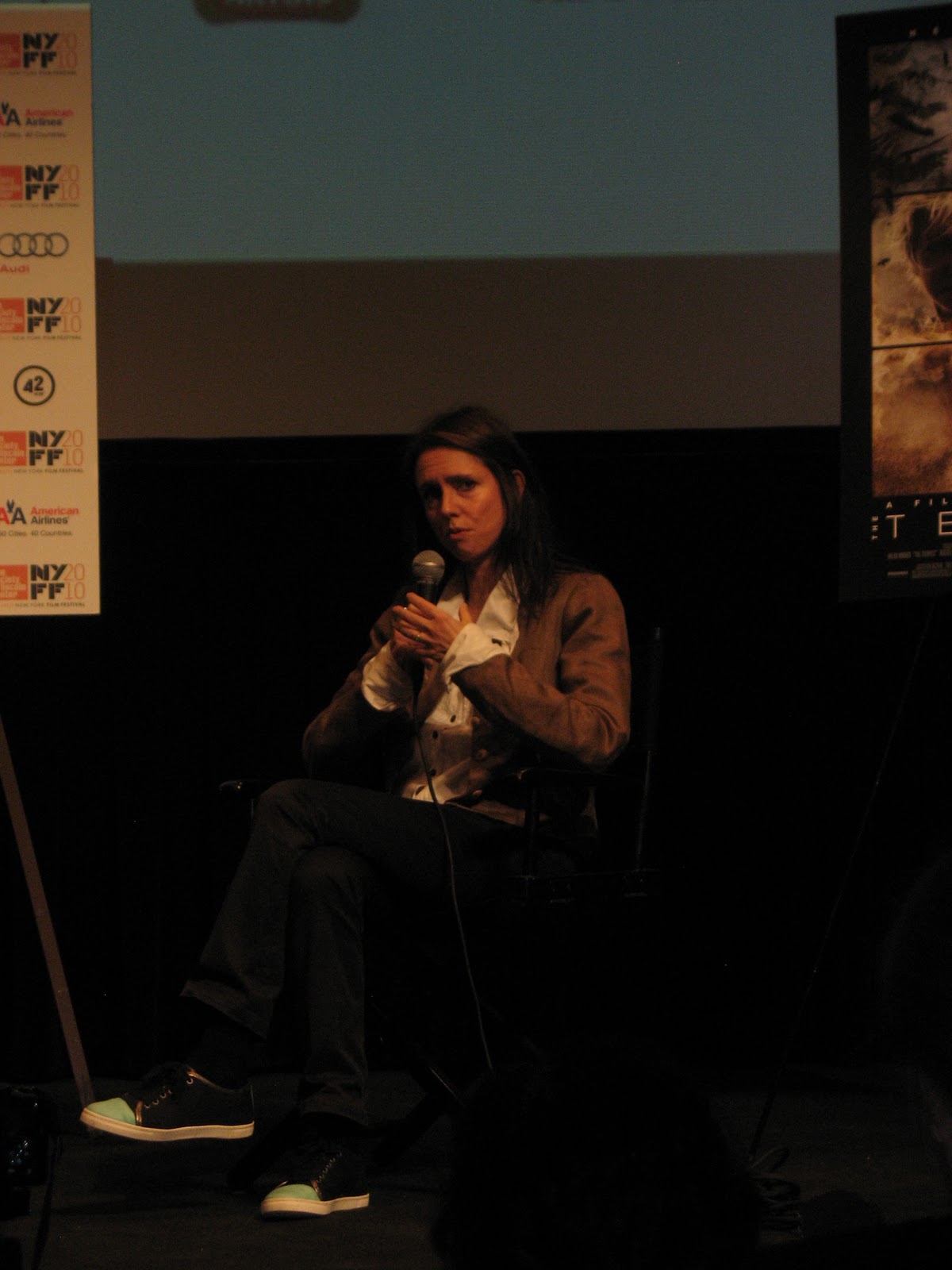
NYFF Interview: Julie Taymor (The Tempest)

Why The Tempest, after Titus, why did you choose this as your next Shakespeare adaptation?
Actually The Tempest was the first Shakespeare play in 1986 with Theater for a New Audience, and I fell in love with the play then, and I directed it three times. And after Titus, in 2000, I decided if I were to do another Shakespeare it would be The Tempest. It’s one of his greats. I had loved it. I fell in love with it in the theater. I don’t think I’d of like to do a Shakespeare film without trying it in a theater first because the paired down minimalism—what you have to do in a theater—you would have to really do it with the actors first. It lends itself to the cinema. It’s extremely visual, and in fact his most visual play.
Having worked on the play several times, what has subsequent readings revealed to you?
One of my favorite scenes is the one where Prospera, in this version, and Ariel talk about compassion and forgiveness. She say, “What do you think spirit? Shall I forgive him?” And he says, “I would if I were human.” And I just find that compelling, both emotionally, and what Shakespeare is saying that all the joy and run of revenge is ultimately about forgiveness and making your way through that.
It’s very different, and in many ways this [film] is saying some of the same things about the play, but my version in the play was a black sand ground with a white site, so the image of the clowns—the fools—was in the original production, in the silhouette. There are many things that haven’t changed, but once Helen Mirren went into the play, without changing the lines, things changed immensely. Not just because she’s a great actress but also because the dynamics were so different. In my stage version, it was a male Prospero, and a female Ariel, although it was just a floating head. Caliban was with a New Guinea mud man mask, and in the film, I didn’t want to hide Ben Whitshaw’s face or Djimon Hounsou’s face, so that brought a different sensibility to those characters as well.
What was your rehearsal process like for the film, in comparison to the stage?
In the theater, you get all your actors on day one, and you get them for five or six weeks before you go into tech. Helen worked on it for four weeks. We did a reading a year in advance because it was extremely critical to both Helen in myself that this wasn’t a gimmick, that is had validity as a Shakespeare play, and it wasn’t about putting a woman in, because obviously you had to change many of the words, the he’s to she’s, the lords to what, the master to what. It’s very interesting because we kept the word master because the word mistress doesn’t mean the same thing. It’s incredible in the English language about what words change and which don’t. We used to word Mum as opposed to mother, and this process of the reading informed us about where we needed to go...
We rehearsed in London with Russell Brand, Felicity Jones, Reeve Carney, and Helen, those actors for about two weeks on and off. And then in Hawaii, where we shot most of the film, I had what we called the court—David Strathairn, Tom Conti, Alan Cumming, and Chris Cooper parts—for not very long, because these actors are very busy. But I did have Djimon, Russell, and Alfred Molina in LA for a hilarious four or five days as well. And we did rehearsals in a bare room where you can really engage with the language and the physicality of it all, before we go to shooting.
In recent years, the character that gets the most scrutiny is Caliban, for obvious reasons. Talk about your conception of that part.
It was very interesting, in my other three production, I had African Americans or Africans play that role. It is a non-white role. If you want to be technical, his father is black and his mother is a blue-eyed hag. He’s just not European in the sense of the world. This play is written in a time in which there were many explorations, many journeys to the New World. He may have been called a monster because he was a Native American, and whatever he was, he was the other. Now, in this version with Djimon, I take Shakespeare at his words, I take him literally. So when he writes, “Thou earth thou speak” or “moon calf,” all these wonderful words to describe, “thou fish thou” I incorporated. He is made of the earth. He is representative of the island because the main theme in this play is nature vs. nurture. And nature, the actual island itself, is Caliban. Is he wrong to have been attracted to Miranda when she comes of age? You watch this conflict in Prospera; she’s a monster at that point for putting Miranda on this island in close proximity with other human beings and its only natural.
It’s about civilization in that sense. So it’s very touchy to put a black man into a slave role, but it felt more honest. It’s not politically correct, whatever that means, but he also has webbed fingers, he’s got a blue eye. He’s got the moon, the two-tone skin that’s he half black, and half white. He’s got this circle—even though that’s not what a moon calf means, I love the idea he looks like a calf, a cow, with these spots. So unlike the theater piece—which I put him in clay as well—he is slightly monstrous in his physical appearance.
How did you conceive of the timing and rhythm for this play for cinema?
Titus was long. It was two hours and forty minutes. And The Tempest is four hours in its full, unedited, unexpurgated version. Now Shakespeare’s plays were never meant to be shown in full, and I had already cut it when I did it years ago to an hour and a half version, and this is probably a little less dialogue and a little longer because I wanted to have certain moments of breathers from the language, but there isn’t a lot. Maybe my feeling is that it is Shakespeare and knowing audience attention spans that I didn’t just allow us to go into these visual massive panoramas—although there are a few—because there is a momentum in the play.
It takes place literally between 2pm and 6pm. It’s interesting because the play is very confusing because she says “Three days hence, I’ll free thee” and at other times she says in three hours. So we played with the idea in time. It was a revelation when I went back to that speech in which she says “I have bedimmed the noon-time sun” and I realized that it was a solar eclipse. So I realized that if I have an eclipse when she starts to do the dark magic on the court, we will be able to go into a theatrical, highly stylized world. It’s very hard to shoot in broad daylight all the time, you can’t control it. And we’re in landscapes where you can’t bring in lighting, we were in cliffs with winds and rain. That’s real stuff. But it was wonderful to pull this sense from the script itself and then bring it to the landscape, and then shoot in green screen or blue screen later on for the highly stylized moments.
Why did you choose to have Beth Gibbons sing the song during the end credits?
That speech, the last speech of Shakespeare’s play, was cut from the film. I never shot it with Helen. I thought we didn’t need it, because she had already done a number of monologues, and what is she going to do, turn to the audience? And even if it hadn’t been end credits, I felt very different. In theater, the house lights come up, the actor unmasks himself, and the artifice is revealed. That really doesn’t happen in cinema.
And then we got to the end of the film, when we were editing, and you had the Ben Whitshaw-Ariel song, and the volcanic glass staff shatters, and I thought two things. One, what are we going to do for end credits, because we don’t have any more money, and on the other hand I thought, its not enough, we need that speech. So [composer] Elliot Goldenthal and I discussed taking that speech and tailoring it a little bit, so a few things are edited from it, and Beth came to mind because she felt like Helen. She has an incredible vulnerability and power simultaneously. The song was written with Beth and mind and we were proud that we could show her the film, and she says yes immediately. Some people have told me they thought it was Helen, but I can tell you, Helen doesn’t sing.
I always thought that it was problematic that Prospero destroyed his magic and gave away his book and I know the speech says “What strength I have is now my own” and that’s the usual interpretation, but clearly the evil is still abound. Sebastian isn’t any better than what he was and neither is the brother. I wonder about your thoughts about this?
I love it because Shakespeare was a realist, and he do these silly things where the bad guys are fully punished and the evil is truly gone. He is so cynical about the world and the most beautiful thing about Shakespeare is that he can be passionate, romantic, and cynical at the same time, and one doesn’t give weight to the other. He can have the most beautiful story about first love, first sight. And think about Ferdinand and Miranda—we talked a lot about the chess game, where she says to him, “You should cheat” and it’s like she already knows what’s in store for her. So what is he saying there? He’s already saying that this youth this innocence is already on its way to corruption.
The character of Prospero and Prospera has done everything in service of the daughter. “I do this for thee my daughter thee my loved one.” I think in this version what we feel really strong about is when Prospero gets his robes back, he just becomes the duke again. But in ours, because it’s a corset, and you go from these androgynous free clothes that you wear on an island and be comfortable, back into that severe female corset, she’s not just giving up her magic, she’s giving up her freedom. So “every third thought will be my grave,” that entire speech is so powerful, as she has that corset tied by Ariel, she goes “So…here I am. So.” And she’s ready to act with these guys.
And we always say, Antonio doesn’t say anything. He doesn’t say anything from the circle of fire to the end, and it’s all in Chris Cooper’s face. This is where cinema is so powerful in a way—I love doing things theatrically but I love doing Shakespeare on film because the acting can fill in the blanks with his or her attitude. The whole ending with Caliban is not the play. It’s unspoken. But the fact that in the end of the play, he/she says “Go into my cave” and he says “Oo I’ll be beaten to death” and he retires into the cave. Since 1986, I’ve felt that isn’t satisfying. I do feel that Prospero or Prospera has made a move, and I feel that Ariel is there to open that. Ariel is the spirit. This I didn’t do in the theater, but that moment where he looks at the staff, and she looks into his eyes, and he looks into her eyes, and she does not lift the staff, which is the only way this white woman is going to have power is through this staff of magic, he walks up those steps and doesn’t look back, and you see what that means in her face. Even when she says, “This thing of darkness I acknowledge thee as mine” that acknowledges that this is her thing of darkness, that she has created this thing of darkness.
What happens is that you can direct these plays 100 times, and you can’t believe what happens. Elliot and I sit there in the editing room or with my editor Francois, and every day we are honored to get something more out of the language, and having actors you get it on so many levels. You get it on the surface level but you also get these riches coming form Shakespeare’s mind.
Click below to read the full interview
Thursday, September 30, 2010
NYFF Interview: Xavier Beauvois (Of Gods and Men)
 |
| Xavier Beauvois |
Xavier Beauvois is a stern filmmaker, and highly outspoken when it comes to politics. Both an actor, and now a director by trade, his film Of Gods and Men has been one of the highlights of the New York Film Festival, a truly moving picture that approaches an extremely difficult subject with grace, civility, and care. Below, along with his co-screenwriter Etienne Comar, Mr. Beauvois discusses his idea process and his politics in making such a film.
When I saw the film I was first surprised that in the 1990s there were communities of French religious living in Algeria. I thought that would have ended much sooner. Could you talk a little bit about the continuity of those communities, and was this one in particular a very unique community, or one of the last ones left?
Beauvois: There are still a lot of these types of communities for example in Morocco. The last survivor, Jean-Pierre, is at the monetary there. Also for example there is one in the Sinai, which the location is a mosque, but it is an old one. There are many such communities, but there are many where they are no religious. For example, doctors, entomologists, and others work in Afghanistan, who are there to help the people and who are martyrs as well, because they end of getting killed.
Could you talk about how you put together the screenplay? Especially with the daily life of the monks—what they did on a day-to-day basis. Were there records? Did you talk to people?
Comar: There were actually quite a lot of things written about this. For example, many of the brothers in the film kept journals that they wrote in every day, including Christian, who you see writing in the film. Also, because in 2006 was the ten year anniversary, there was a lot of things published articles just describing what they’re lives were like. So there was a good amount of information about this. Also, once we started shooting, there was a lot of work that we had to do. So we visited other monasteries to see what their life is like so we could have a practical picture.
Beauvois: Also I did take a few liberties. For example, where the actual monastery was located there were a lot of fruit and vegetable gardens and orchids, and where we shot just wasn’t the case. So what we did was transpose the idea of the gardens and the fruit into honey. So honey became the replacement for it.
There’s an extraordinary sequence with Swan Lake playing, and you have the cutting between all the faces. Could you talk about how you conceived of that sequence?

Beauvois: In the first version of the script, my idea was to have a long scene together where they were perhaps doing the dishes and singing. But then I thought, this might not be very interesting because they’ve been singing throughout the film and also because these are non-professional singers it might not be that interesting. Then I hit on the idea of listening to music instead, and I was listening to a lot of music through my headphones, and I came upon this excerpt from Tchaikovsky’s Swan Lake and I suddenly had this idea in my head. I suddenly saw the whole scene and started to cry and then I couldn’t show anyone I was crying, but this was my idea that it was the music. In French, there is a play on words; the word for director where part of the word is also the word for the Last Supper. So I had this idea where Christian as Jesus with the disciples around him. It was a challenge but it just came so vividly to mind.
There’s a bit of dialogue early in the film about girls who are unveiled on the bus. This film is set in the mid-90s in Algeria, but it has a very contemporary feel with the questions of veiling in France. Was that an accurate depiction of what was going on in Algeria at that moment?
Beauvois: Actually no the whole question of girls wearing headscarves had already begun around that time, but this of course is something that is really big right now. In France, they are trying to make people as afraid as possible, so the issue now has become the burka, which covers the head entirely, and it sort of has these phantoms in cinema. The actual number of women—who wear the burka—are probably 0.00001%, maybe 500 women in all of France. And yet this very small percentage of women has really come to monopolize the French press. Perhaps 50% of the French press is devoted to this issue, and what it really is, is an attempt by the Sarkozy government to divert people’s attention from what the real problems are, which are problems surrounding poverty, about people not having enough for their retirement, about suicides over economic troubles, so its really a way of diverting their attention, since it affects such a small number of people.
Comar: In 1993 through 1996 there were many, many killings, about 170 Algerians, Imams, intellectuals, people in the street, religious, so all the stories are larger than what is going on in this film.
 |
| Etienne Comar |
Beauvois: You’ve had countries like France where girls are fighting to wear headscarves and insisting they be able to do it, where you have other countries where people are fighting not to wear them, or all traditional Islamic wear for women. And in both cases these women can be Algerian but they could be women in Algerian, or Algerian women in France, and its almost surreal, because of this episode…Just to imagine if one day, President Obama declared that people who get dressed up like Batman and try and scare children should be banned. Then you’d get an idea what this would be like.
Going back to the use of Swan Lake, which happens to be not a religious piece, but specifically a secular piece…
Beauvois: Actually music for me is very important I listen to it all the time, for example Sergio Leone and a lot of composers who’s music is used in films. But for myself in using it for my own films, I find it more problematic. For example in my previous film The Young Lieutenant, there was no music at all. What I don’t like about using music in films is I don’t want to cue the viewer when to laugh, when to cry, not to emphasize it by having music. So in this film, there really isn’t any music other than this Tchaikovsky episode, other than the religious music, which is part of their daily lives in the monastery. I think that its significant that the last music that you hear is secular music, and it was important to me because this movie is about men and gods, and perhaps this was the closet they could come to be gods, but they were also just men…I think when you think about it during great moments in life, like great moments of sadness, you are out in the street, there’s no soundtrack behind you. Same thing for kids. They’re on top of the world, and they’re screaming, and there’s no music behind them either.
The scene where the monks links arms when the helicopter is overhead is quite powerful. Was it something you got from the journals or was it something invented?
Comar: It was something completely invented by Xavier but at this time, in the monastery, there were many army operations in the area, because this area was very dangerous, and there was a lot of terrorist threats. So the helicopter was coming some time and very close to the monastery, and some jeeps and some tanks. So we expressed the idea of what was happening there in the scene. But it wasn’t something that they wrote, or was told, it was simply invented.
Beauvois: I always have a very hard time answering where these ideas come from because once you start developing a story and becoming part of a story and filming a story there are a lot of things happening where its not just the story itself. It’s the feelings that are connected with it, the odors that are connected with it. All of these things serve to bring ideas into my head. Sometimes the ideas are symbolic of whatever I’m thinking about and showing. Or some of them are to summarize the things that I have. But it’s a very bizarre thing to tell you exactly where these ideas come from. But one thing I wanted to tell you about having the helicopter over the monastery is that there are many theories about how the monks were actually killed in the end, and one of them is that it was a mistake by the Algerian army, and they were killed by a helicopter attack on the terrorists. So I thought it was good to have this helicopter over them, with the machine guns, and they’re a constant presence over them. So I wanted to hint at that to be present, but I’m not particularly promoting any one theory about what happened, but also I like the idea of trying to show that by linking arms and singing, by song, it’s the contrast by the machines of war that are represented by the machine guns on the helicopter.
One of the great challenges to make a film like this is to create a community of men who are true believers, who believe in something, and that belief fills them and really guides their life. How do you create that belief that is really fundamental to the film?
Beauvois: Actually, if you think about it before you have belief, before you have faith, you have freedom, you have equality, you have brotherhood. Liberté, égalité, fraternité is the motto in France, and what we have here are men who are free men. They are free men who see themselves as being equal to each other, but also brothers as religious brothers, but also with the Muslim people. So these are basically humans. Unfortunately, what we now have in France is a situation where people are a little less free and a little less equal and a little less fraternal. And I think that the important message is that this is really a question of intelligence. These are really people who speak with each other, they question each other, they’re interested in each other and they approach if from that angle rather than one of proselytizing one faith over another. Frankly, I could never really make the film if it was about proselytizing with these missionaries; that was not the case with these men….Actually, an incident happened to us yesterday. We were walking around the city and we saw a Jewish family—the father was wearing a yamaka and was with his wife and child—and they crossed paths with an Arab family—the woman was wearing a veil—and they knew each other and were saying, “Oh hi how are you?” We really stopped and looked at this because this is the message of what my film is, but its not something you would see in France.

What do you see as the message of your film? About hope, about religion, and about reconciliation?
Beauvois: Well first of all, this is a film, and I would hope that it could make some sort of impact, but first of all, it was made as a film, and what happens after, once its on the screen, and we can fantasize what we want. I don’t know what this would correspond to, but we had one million tickets sold in 15 days in France, which is an enormous success. And I think why its had this success in France is people have a need for this kind of reconciliation. I think people have had enough of ego building, and bling bling, and Sarkozy-ism that’s been prevalent up to now. And perhaps its this desire to return to things that are more simple, and I don’t want to be pretentious, but perhaps I hope that my film will encourage people to talk to each other and perhaps have an atmosphere that is less fearful. Schindler’s List was a film that really changed things because a lot of people didn’t know what was had happened during that time and I hope this film can do something similar.
Comar: There’s also something that I’ve been surprised by since we started the project together is the fact that in 1996 when this drama appears, this question between Muslims and Christians was not really spoken even in France. There wasn’t a lot of press about this crime, and how they died etc. But during the anniversary in 2006, it was ten years after that, and we were in the post-2000 years, which is a very different world, and there were a lot of stuff about the fact that what they were saying in 1996 makes it feel like now. They were saying things out of peace, a lot of Ghandi, and Martin Luther King. So this message was quite relevant in the film.
Subscribe to:
Posts (Atom)