Showing posts with label akira kurosawa. Show all posts

Friday, April 25, 2014

Link Round-Up: Va-Va-Boom!

Many, many updates follow. I promise to be better at doing this more than once a month.

My Masters Thesis for Columbia University is being updated, revised, and expanded for a book! Coming in October from The Critical Press, you'll be able to purchase Approaching the End: Imagining Apocalypse in American Film. The book will cover my theories on film noir and its connection to American melodrama and various atomic, religious, and technological apocalyptic narratives. You can read an expanded note on what will be covered here.

Another thing worth picking up: Little White Lies's May issue, which is dedicated to Richard Linklater. There are fantastic pieces by Jordan Cronk, Gabe Klinger, Vadim Rizov, and editor David Jenkins. My own piece covers Linklater's films set outside of his homeland of Austin, Texas, which covers the Before films, School of Rock, and Me And Orson Welles, you can pre-order the issue here.

The Criterion Collection continues to be busy. I reviewed a number of new discs for The Film Stage, including Dreyer's 1925 silent curiosity, Master of the House, Akira Kurosawa's "this is so much more than Star Wars" epic The Hidden Fortress, and three newly restored shorts by Harold Lloyd, which can be found on the new Blu-Ray for The Freshman. 

My conversation on "dated films" with Abbey Bender wrapped up on To Be (Cont'd). You can read the first, second, third, and fourth posts here respectively. Then check out the April conversation between Glenn Heath Jr. and Tim Grierson on the work of Jonathan Glazer. I gave my own brief on his new film, Under the Skin, over here.

If you aren't following The Cinephiliacs, you've missed conversations with Dana Stevens talking about Portuguese poetry and Max Ophuls, Mark Harris on his fantastic new book Five Came Back and the Hollywood directors who went to war, and Matt Lynch on America's largest independent video store and the morality of John Woo.

Over at Letterboxd, I've written some posts on
New Films! Wes Anderson's The Grand Budapest Hotel, Juame-Collet Serra's Non-Stop, Albert Serra's Story of My Death, Hong Sang-Soo's Our Sunhi, and The LEGO Movie.
Canonical Works! Stranger Than Paradise, An American In Paris.
Really good things off the radar! Powell and Pressburger's Oh...Rosalinda!, Richard Fliecher's Violent Saturday and Barabbas, Claire Denis's No Fear, No Die, Jacques Rivette's Secret Defense, Robert Mamoulian's Love Me Tonight, and Sweetgrass from Harvard SEL.

Finally, I'm proud to announce that in the fall, I'll be switching coasts and beginning my PhD in Critical Studies at the University of Southern California. The move is somewhat terrifying, but I hope to continue to keep trying to provide fantastic writing on film and more.

Friday, October 25, 2013

Kurosawa, Cinephilia, and Seven Samurai

Kurosawa is part of a contentious tradition now with Bergman and early Fellini in cinephilia for not making "open" movies. The main claim would be that their perfectly executed, pictorial frames do not allow for interpretation beyond what they present. These films do not require explanation in the way that their counterparts - Mizoguchi, Rosselini (only the latter works) and Antonioni respectively – make films that are only legible to those who have truly engaged with cinema. While I could point to Andrew Tracy’s piece in Cinema Scope at the time of the AK100 Criterion set (“prompts the question of why his presence among the most active and engaged sectors of present-day cinephilia feels so pallid,” a sentence that certainly doesn’t engage in any sort of exclusion process) or even David Bordwell’s defeatist attitude (“I still find most of his official classics overbearing, and the last films seem to me flabby exercises”), this would be falsely presumptuous to lay the blame on contemporary shoulders.

Instead, we can go all the way back to Cahiers Du Cinema to find the origins of such debate. Luc Moullet on Drunken Angel: “Its aesthetic pretensions…surpass in their grotesqueness anything even the European Cinema has produced,” and Ikiru: “As for the ending with the swing, confronted by such a piece of idiocy and affectation the audience is left speechless.” Jacques Rivette too, who notes “those ‘picturesqure qualities that made for the facile success of The Seven Samurai, of which we may now rightly ask whether it was especially aimed at the export market.” And Godard’s famous comment, “merely a more elegant Ralph Habib.”  Bazin was more cautious, noting his own (and I’d admit my own) preference for Mizoguchi, while writing “I wonder whether, instead of considering Kurrosawa’s cosmopolitanism as a commercial compromise, albeit of superior quality, we should not rather see it from now on as a dialectical progression pointing the way forward for the Japanese cinema.”*

Friday, August 03, 2012

My Cinephiliac Moments

            “I think it’s a fun picture,” said Alfred Hitchcock of his film Psycho (#35), which is how I feel about the release of UK-based film journal Sight & Sounds decennial list of the “Greatest Films of All Time.” Some people are furious about it. Some people are dismissing it. I fall slightly in the middle. Oh yes this or that or whichever isn’t on the list, but it’s a list, and like Hitchcock thought of his film, it’s fun, and it’ll be fun to see a new generation of cinephiles discover Vertigo (and of course write think pieces about how it’s overrated).

            Sight & Sound “forgot” to mail me a ballot this year, though I’ve written sketches in the past of how my list may parse, and don’t see why I should just print that out again, because honestly there’s too much I still haven’t seen (six films from the 2012 list – Shoah , Journey to Italy, Panther Panchali, Gertrud, Historie(s) Du Cinema, and Ugestsu Monogatari), and what’s the point of “another” list? That list is great, and everyone should see those films.

            Instead, I’ve been thinking a lot about a blog post written by Girish Shambu about “the cinephiliac moment” (I’ve been reading Shambu’s blog for a while, but I found this one through some accidental Google searching related to a certain podcast). Shambu interprets from Christian Keathley’s Cinephilia and History, Or The Wind in the Trees that the cinephiliac moment being the moment in which cinema takes over, and tantalizes you. Shambu writes:

“The important thing to remember is that these are not moments carefully designed to exert great dramatic effect—not that there’s anything wrong with those—but instead they are fleeting "privileged" moments writ small that we find ourselves strongly attracted to, perhaps even disproportionately so given their scale and possible (lack of) intention.”

            I don’t know if my cinephiliac moments follow exactly Shambu’s reasoning – some of them after all are quite big moments in the films they came from, and certainly they aren’t “accidentals” as he states it. But these moments unlock my deepest moments of cinephilia, the point in which I realize why I keep going to the movies. I started at five, and then it soon became twenty five, and then narrowed it down to eleven. They are presented in no order.

Add your own in the comments, or link me to your piece and I’ll include a link here.

Tuesday, May 01, 2012

Interlude: Sight & Sound

Following the take from some friends...no commentary, just a list of films I can't live without. This list will be out of date in about five minutes.

1. Vertigo (Hitchcock, USA, 1958)
2. Raging Bull (Scorsese, USA, 1980)
3. Do The Right Thing (Lee, USA, 1989)
4. High and Low (Kurosawa, Japan, 1962)
5. Rio Bravo (Hawks, USA, 1959)
6. 2001: A Space Odyssey (Kubrick, UK, 1968)
7. The Passion of Joan of Arc (Dreyer, France, 1928)
8. Sunset Blvd. (Wilder, USA, 1950)
9. Days of Heaven (Malick, USA, 1978)
10. The Searchers (Ford, USA, 1956)

Not included: Psycho, The Godfather, Close-Up, Pulp Fiction, Chinatown, Annie Hall, The Apartment, Sweet Smell of Success, Chungking Express, The Godfather: Part II, and a whole lot more...

Saturday, September 18, 2010

Spirits of the Samurai: The Angel of Death in Yojimbo

A small precursor: I am taking a class in Japanese Cinema, and will be writing thoughts about some of the films here as the class progresses. 

I also apologize for the lack of updates, but as summer ends and school begins, what can you do?

      In Akira Kurosawa’s
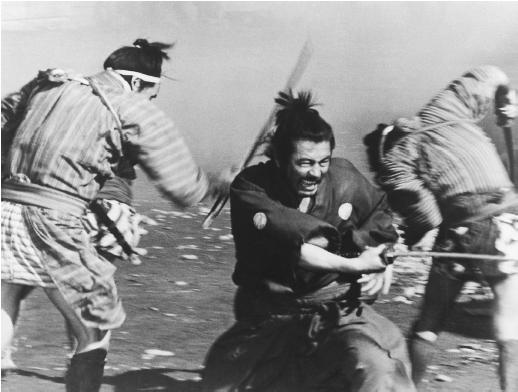
Yojimbo (1961), the director presents a protagonist that seems to hinge on angelic and supernatural qualities. Kurosawa uses a number of curious visual and scripted clues to allude to this strange quality, which helps fuel the deeper moral question the film suggests by the end.
The character played by Toshiro Mifune, is firstly known as Sanjuro Kuwabatake, but that name seems to be a play on the fields that Sanjuro stares at the moment he says in name, as well as his age. A precursor to the Man With No Name from Sergio Leone’s A Fistful of Dollars (1963), Sanjuro enters the town with no objective, but only as a curious observer. When he learns of the two warring clans, he decides to exploit and kill both. For Stephen Prince in his book The Warrior’s Camera, Sanjuro “has no ethical reason for doing so, no ideal to which he commits” (223).
However, Sanjuro is surely fighting for the side of good, even if he is ever so hesitant to reveal such an ideal. The samurai never attacks anyone on purpose, his main fights are when he is being attacked by others and thus defends himself. In fact, he only intervenes in the action twice in the film—to save the kidnapped woman from the men (which someone  suggests would take the power of sixteen men), and during the final battle, when is main objective really is saving Gon, though he does slaughter the remaining bodyguards in the process. Also of note is that Sanjuro kills neither of the lords that are in the feud, only the men who protect them.
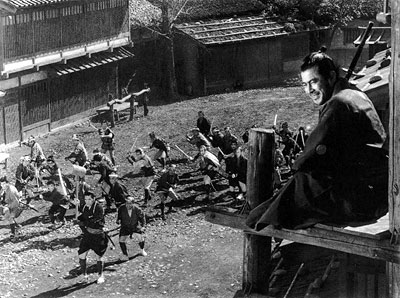
      Sanjuro carries some angelic qualities, and Kurosawa often portrays him as if from another world. Not only does he have no name or past, but also he is emotionally removed. For most of the film, he is reserved and joking, and “amused” by the war between the villagers. The performance by Mifune is also atypical of him, reserving his emotions only for the bloody battle sequences, as compared to his larger-than-life emotions in films like Seven Samurai (1954) and Throne of Blood (1957). Additionally, in one of the film’s most iconic shots, Kurosawa uses a low-angle shot of Sanjuro sitting high atop a perched outlook as the two sides attempt to fight, not only making him emotionally and philosophically above the fight, but literally as well. This is not without mentioning his overall strength compared to every one of the bodyguards in the film, none of which put up much of the fight, except for the nameless gunfighter, who is in many ways also a deity of sorts, not only by his anachronistic weapon, but his entrance in tumultuous weather in which the constable notes how, “even the wind welcomes you.”
      Kurosawa uses the camera in more pointed ways to suggest Sanjuro’s angelic qualities, most notably a gag in which Sanjuro hides in a coffin, suggesting he has already died, and Gon even tells him he looks like he is dead after he has been kidnapped. Donald Richie in The Films of Akira Kurosawa also notes his ability to control the film itself, using the non-diegetic sound. He writes, “When Mifune initially calls on one of the bad leaders he climbs the stairs, slowly. After each step, in the silence between each footfall, there is music. It is like secco reccitaif for the dance” (153). Prince also mentions Sanjuro’s actions directly controlling the narrative of the film, calling him “a kind of surrogate director” (224). In the film’s final shot, Kurosawa continues this suggestion, as Sanjuro literally fades, and as Prince describes it, “Like a shadow flitting across a wall” (231).


     So why make a film about an angelic figure intervening and destroying the lives of humans? One interpretation is to read the film as Sanjuro’s sick joke on Gon, who finally gets the town to be “quiet” in the end. The film certainly fits in with Kurosawa’s other films that deal with ambiguous moral grounds, such as High and Low (1962) and Stray Dog (1949). Kurosawa does not see Sanjuro’s actions as the morally right solution, though he does not propose any other solutions. The town may be quiet, but the path of destruction left only leaves Gon and the few people left to a life of even greater devastation. One could read Sanjuro in a political and historical allegory of the United States “cleaning” Japan, as the images of the destructed town seem to recall photographs of the firebombed villages, but such a reading is too easy and too simplistic for Kurosawa’s intelligence. Instead, Kurosawa has offered up the ultimate morality play about the control of power, and who is allowed to fight battles for others. The ultimate joke seems to be played on Gon. He wants his village to be quiet, a promised that is fulfilled, but the consequences devastating. 

Two Texts were referenced in the above article: