Showing posts with label film studies. Show all posts

Friday, November 09, 2012

Image of the Day and Some Notes on Hitchcock Studies


You might recognize the above shot from Alfred Hitchcock’s North By Northwest, as Cary Grant suavely walks through the window in order to escape, and catches the eye of this lovely young woman. What you probably don’t recognize is that such woman is Patricia Cutts, a TV and film actor from the era, who also happened to be the daughter of Graham Cutts.

You might have heard Cutts’s name thrown around over the last year as the director of The White Shadow, the restored “Alfred Hitchcock” movie that was found and will be available thanks to the work of the Film Preservation Bloagathon and Fandor very soon.

I’ve collected some notes based on a small private lecture given by Charles Barr last night about the state of Hitchcock studies, of which he is pretty much the father. The most important point is that there’s a ton of research to be done in early Hitchcock studies, and if you know of any archives relating to the names or films I mention, you should definitely get in contact with me and I'll pass on the information.

Thursday, January 26, 2012

VIDEO ESSAY — The Double Life of James and Juliette: Mysteries and Perceptions in Kiarostami's Certified Copy


Inspired by the recent wave of video criticism that has taken over blogs like Fandor and Press Play (both essential reading/viewing), I decided to try my own hand in writing, editing, and producing a video essay myself. The first, presented above, tackles my favorite film of 2011, Abbas Kiarostami’s Certified Copy. I hope you enjoy this, as I had a great time making the essay, and hope to do more throughout 2012. Any comments or feedback would be greatly appreciated, either in the comments below or by email.

Saturday, September 18, 2010

Spirits of the Samurai: The Angel of Death in Yojimbo

A small precursor: I am taking a class in Japanese Cinema, and will be writing thoughts about some of the films here as the class progresses. 

I also apologize for the lack of updates, but as summer ends and school begins, what can you do?

      In Akira Kurosawa’s
Yojimbo (1961), the director presents a protagonist that seems to hinge on angelic and supernatural qualities. Kurosawa uses a number of curious visual and scripted clues to allude to this strange quality, which helps fuel the deeper moral question the film suggests by the end.
The character played by Toshiro Mifune, is firstly known as Sanjuro Kuwabatake, but that name seems to be a play on the fields that Sanjuro stares at the moment he says in name, as well as his age. A precursor to the Man With No Name from Sergio Leone’s A Fistful of Dollars (1963), Sanjuro enters the town with no objective, but only as a curious observer. When he learns of the two warring clans, he decides to exploit and kill both. For Stephen Prince in his book The Warrior’s Camera, Sanjuro “has no ethical reason for doing so, no ideal to which he commits” (223).
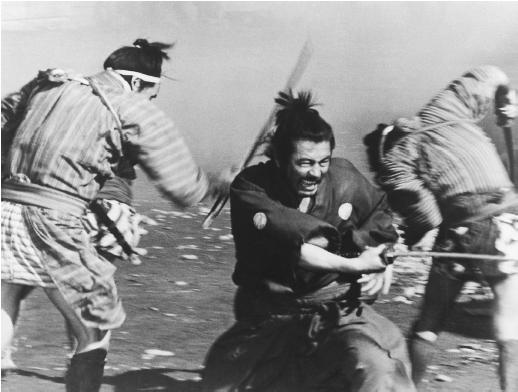
However, Sanjuro is surely fighting for the side of good, even if he is ever so hesitant to reveal such an ideal. The samurai never attacks anyone on purpose, his main fights are when he is being attacked by others and thus defends himself. In fact, he only intervenes in the action twice in the film—to save the kidnapped woman from the men (which someone  suggests would take the power of sixteen men), and during the final battle, when is main objective really is saving Gon, though he does slaughter the remaining bodyguards in the process. Also of note is that Sanjuro kills neither of the lords that are in the feud, only the men who protect them.
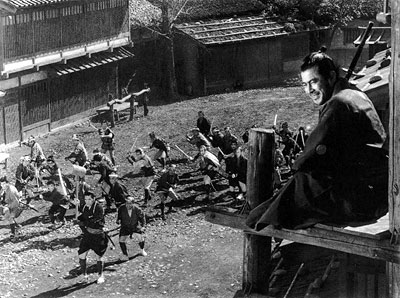
      Sanjuro carries some angelic qualities, and Kurosawa often portrays him as if from another world. Not only does he have no name or past, but also he is emotionally removed. For most of the film, he is reserved and joking, and “amused” by the war between the villagers. The performance by Mifune is also atypical of him, reserving his emotions only for the bloody battle sequences, as compared to his larger-than-life emotions in films like Seven Samurai (1954) and Throne of Blood (1957). Additionally, in one of the film’s most iconic shots, Kurosawa uses a low-angle shot of Sanjuro sitting high atop a perched outlook as the two sides attempt to fight, not only making him emotionally and philosophically above the fight, but literally as well. This is not without mentioning his overall strength compared to every one of the bodyguards in the film, none of which put up much of the fight, except for the nameless gunfighter, who is in many ways also a deity of sorts, not only by his anachronistic weapon, but his entrance in tumultuous weather in which the constable notes how, “even the wind welcomes you.”
      Kurosawa uses the camera in more pointed ways to suggest Sanjuro’s angelic qualities, most notably a gag in which Sanjuro hides in a coffin, suggesting he has already died, and Gon even tells him he looks like he is dead after he has been kidnapped. Donald Richie in The Films of Akira Kurosawa also notes his ability to control the film itself, using the non-diegetic sound. He writes, “When Mifune initially calls on one of the bad leaders he climbs the stairs, slowly. After each step, in the silence between each footfall, there is music. It is like secco reccitaif for the dance” (153). Prince also mentions Sanjuro’s actions directly controlling the narrative of the film, calling him “a kind of surrogate director” (224). In the film’s final shot, Kurosawa continues this suggestion, as Sanjuro literally fades, and as Prince describes it, “Like a shadow flitting across a wall” (231).


     So why make a film about an angelic figure intervening and destroying the lives of humans? One interpretation is to read the film as Sanjuro’s sick joke on Gon, who finally gets the town to be “quiet” in the end. The film certainly fits in with Kurosawa’s other films that deal with ambiguous moral grounds, such as High and Low (1962) and Stray Dog (1949). Kurosawa does not see Sanjuro’s actions as the morally right solution, though he does not propose any other solutions. The town may be quiet, but the path of destruction left only leaves Gon and the few people left to a life of even greater devastation. One could read Sanjuro in a political and historical allegory of the United States “cleaning” Japan, as the images of the destructed town seem to recall photographs of the firebombed villages, but such a reading is too easy and too simplistic for Kurosawa’s intelligence. Instead, Kurosawa has offered up the ultimate morality play about the control of power, and who is allowed to fight battles for others. The ultimate joke seems to be played on Gon. He wants his village to be quiet, a promised that is fulfilled, but the consequences devastating. 

Two Texts were referenced in the above article:

Thursday, August 05, 2010

Inception Continued: Dreaming Reality


Spoilers for Christopher Nolan's Inception Follow

            In what will hopefully be the last words I have to write about Inception (which is false considering my upcoming study on Christopher Nolan’s philosophy as embedded in the final choices and perceived realities of his protagonists), there has been one particular criticism of the film that has slightly baffled me. While I am not the film’s most championed supporter, I find this particular “fault” in the film slightly strange. The argument is best summarized by A.O. Scott in his New York Times review: 

“But though there is a lot to see in “Inception,” there is nothing that counts as genuine vision. Mr. Nolan’s idea of the mind is too literal, too logical, too rule-bound to allow the full measure of madness — the risk of real confusion, of delirium, of ineffable ambiguity — that this subject requires. The unconscious, as Freud (and Hitchcock, and a lot of other great filmmakers) knew, is a supremely unruly place, a maze of inadmissible desires, scrambled secrets, jokes and fears. If Mr. Nolan can’t quite reach this place, that may be because his access is blocked by the very medium he deploys with such skill.”


“It's all so neatly organized! In other words, not dreamlike at all. Just disappointingly flat, sterile, cold, rational. If a filmmaker is going to dream, the challenge is to dream big, to show us things in ways we haven't seen before, not to simply regurgitate indifferently executed clichés from action pictures and heist movies: car chases, kidnappings, gunfights, interrogations, elevators, ski chases…”

            Both these critics, who are among many, point to the fact that Christopher Nolan gives us a dream world, and the decided to not explore it, something that David Lynch would never do. The dreams, whether inspired or not, are purportedly grounded in something that could exist in the real world. The car chase through LA is cold and dreary, the hotel, at least before the world starts shifting, is plain, and the snow fortress may have an interesting design, but its nothing out of the ordinary. The worst of it is the area called “Limbo,” where apparently all of the universe’s unkempt dream space is stored. When Cobb and Adrianne arrived there, it is quite massive—skyscraper after skyscraper after skyscraper…and that’s about it. No cosmic designs in the sky, nothing floating around, simply a big mound of cement.

            However, I think we need go back to Inception’s own inception, and the starting idea. If we can consider what was the idea that inspired Nolan to make this film, which can be difficult considering how muddled the film is thematically, one idea keeps coming back: how do establish the difference between dreams and reality? I think if we consider that idea, along with what Nolan does with the mise-en-scene of his film, there are some quite radical revelations. Instead of giving us something out of this world, Nolan takes his cues from Michael Mann's often ultra-realistic films, and attempts to show us a dream world that we can believe in. In Inception, the goal of Cobb’s team is to trick the dreamer, and thus the viewer, that they are not dreaming. Which is why the dreams look real.

            Nolan seems to be taking cues from the philosophy of quantum physics: even the most random things are bound by specific rules. Everything in the universe that we know follows logic. So why are dreams so different? Is our subconscious unhinged or do we simply think it is not bound by this universe? Nolan takes these notions by creating what can only be described as “dream logic,” attempting to understand how our dreams could function. He lays on blunt ideas, uses his made-up scientific jargon repeatedly, giving us rule after rule in his dreaming. 

            Thus the look of Inception—the cold, dreary, almost dead-less look, is one of order. If Nolan deserves praise on a thematic level, it is because he goes against the typical rule of how dreams should be. He bounds them to their realistic existence. What I hope Nolan is going for is not the already crackpot notion that our reality may just be a dream, but the opposite, that dreams are simply another for of reality, and thus of existence.

            However, this thematic and philosophical idea, the problem that Scott and Emerson find an issue with, is problematic for its own reasons. The layers of exposition take us away from exploring these notions, and when things should start getting crazy, as dreams “collapse” and the subconscious of different characters collide, Nolan sticks to his rules. He’s not willing to take it to the extreme and sticks to what he knows. This is why Limbo is so disappointing—we know that this world could be anything, where Cobb and Mal had full control of anything they could create, and instead they make a plain metropolis that is as cold and meticulous as anything else in the film.

            Nolan, for all his spectacle, is too rational of a filmmaker. He constrains himself to genre tactics, and his ideas are thus buried and have to be extracted. Cobb explains early in the film to his father,” "It's the chance to build cathedrals, entire cities, things that never existed -- things that couldn't exist in the real world," but Nolan has no interest in what can’t exist, only what can. Nolan thus is so bogged down in his rules that thematically, Inception is either point blank or not really saying much. While I have defended the decision of Nolan to explore the dreamscape as a form of reality, I think that is where the imagination stops and reality begins. 

           I repeat what I said in my original review—the more complicated Nolan's films have becomed, the less thematic relevance has been built in. There is a lot to discuss in Inception ("I swear I saw the totem fall!" or "You didn't see the shot of Cobb and Mal's hands when they were old?"), but none it leads to the same discussions that one would have about films that Nolan is reaching for: say 2001 or Blade Runner. Which is why reality for Nolan is a gift and a curse. He creates something truly original, but then again, we've seen it all before.

Wednesday, August 04, 2010

No Laughing Matter: The Death of the Romantic Comedy


The Bounty Hunter

           New York Times columnist Maureen Dowd used her column today to address an issue that is not exactly ground breaking, but one that seems to pop up every few years or so. When are we going to get a good romantic comedy. The article is a discussion between her and the young writer Sam Wasson, who’s book Fifth Avenue, 5 A.M. follows the making of Breakfast at Tiffany’s.
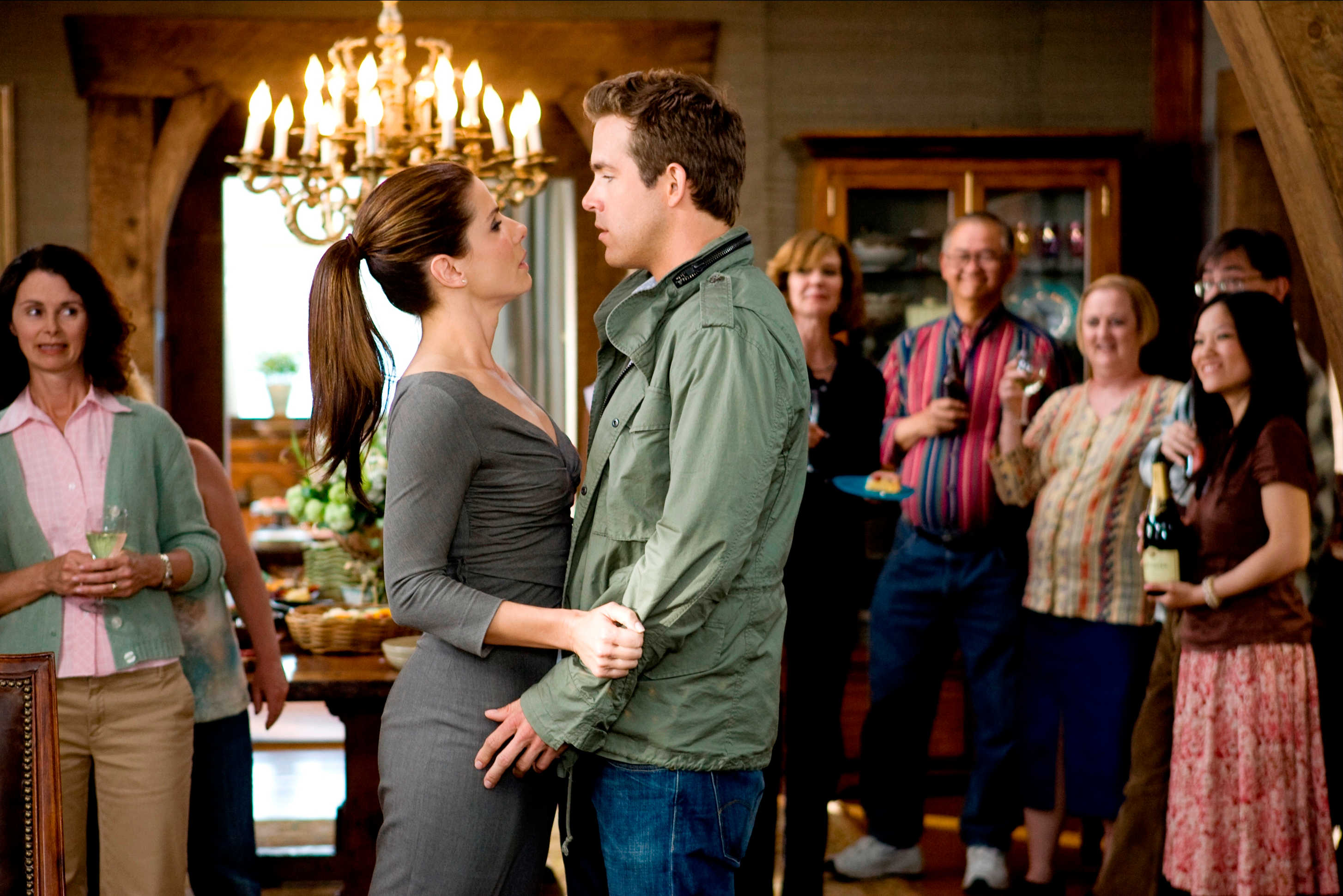
            Dowd asks Wasson, “Where are new Sturgeses and Lubitsches?” and Wasson replies with some modest remarks for Jason Reitman but ultimately a fallen hope for anything close to a great romantic comedy in the future. The two drop movie titles like hot cakes: He’s Just Not That Into You, The Bounty Hunter, Knight & Day, all terrible movies (or at least I’ve been told about the formers, while my review of Knight & Day was not in any way pretty) that try and be smart and funny romantic comedies. Dowd and Wasson point to one important factor that is a key reason why this matters: Any man can sit down in front of Bringing Up Baby or even Annie Hall and enjoy it. Sit me down in front of The Proposal? I’ll be out of my seat in ten minutes or less.
            Although the article is not as informative as it is an interested read, Wasson makes one point that I think really defines the downfall of the romantic comedy: “Back in the days of one-foot-on-the-floor, wit was the best (and only) way to talk about sex.” Sex, as anyone with a brain knows, sells, and sells damn well. In the era of the Production Code, you couldn’t show sex, so you just included everything but. In Stanley Cavell’s famous book Pursuits of Happiness: The Hollywood Comedy of Remarraige, the famed scholar basically argues that famed screwball comedies are often about characters returning to their married states, thus guaranteeing your ending will be one thing and one thing only: sex. Sure you can’t show it, but your audience will walk away satisfied.
The Proposal
            So when the MPAA took over and Bonnie & Clyde gave us our sex up front, a new formula is born. This formula can be broken down into four stages: The courting, the coitus, the fallout, and the return to coitus. The move changes everything—now our sex appears in the middle of the film, which means our stars need to show more skin at some point, which means the notions of beauty change.
            Here’s one thing I have never understood: the spectacle of the body. When I watch a film, I rarely notice the beauty of the star beyond the fact that she is beautiful. Sometimes it is gratuitous (Megan Fox in both Transformers films), but beauty for me doesn’t signal a break in the film or a distraction (One exception gets me every time, and that is Christina Hendricks on Matthew Weiner’s Mad Men, who uses Joan’s sexuality is very careful ways).
            The idea thus for studios, is this: people want to see these two hot bodies come together. The situations are irrelevant. The sex is the important point. Thus, today’s standard romantic comedy. The reason there is no one focusing on dialogue the same way Frank Capra and Preston Sturges did is there is an idea there is no need to. The Proposal made huge money last summer at the box office, and Valentine’s Day did extremely well last February. When there is a flop, its not the film, it’s the star.
            Woody Allen used to be a savior, simply because his film’s have never depended on the sexual appeal of the star to sell them, though he has often cast very beautiful people and then put them in ugly situations. When Harry Met Sally does a similar thing, and its writer Nora Ephron, has come closest to giving something slightly fresh, such as the romance people Meryl Streep and Stanley Tucci in Julie & Julia. Lisa Cholodenko’s The Kids Are All Right is a gold mine compared to other films, but that itself is independent flare.
            However, when we consider the majority of romance films, its not a pretty site. Wasson writes, “The question is, will there be a backlash? A renaissance? I don’t think people realize how dire the situation is. I mean culturally, emotionally, the whole idea of romance is gone, gone, gone.” The majority of the problem is not the studios, its because we are not asking for smart comedy. We would rather watch Ryan Reynolds and Sandra Bullock go through the motions.
            Studios thought it was a revelation when Inception did well at the box office. Do people really want smart (at least at a surface level) entertainment? But Christopher Nolan’s film is just a blip on the radar. Next summer will be Thor, Pirates 4, The Smurfs in 3D, and order will be restored. To say that the romantic comedy, if it next few iterations perform poorly, could go through a renaissance is only wishful thinking. Thankfully, Netflix Instant Watch is not going anywhere. 

Monday, July 12, 2010

How A Lawless Man Became an American: Clint Eastwood at Film Society


Originally Posted at CUArts


There’s a moment in Clint Eastwood’s Gran Torino in which the actor and director finally reveals the chiseled 1972 titular vehicle in the film. Eastwood’s character Walt remarks he put together the lavish muscle car together himself. It’s hard not to think of the car not only as a metaphor for Walt, but for Eastwood himself. Built tough and rough, shiny on the outside and hardened on every edge, full of might and capable of anything on a long winded road, and yet the car seems to be destined for greater things and a larger freedom that seems impossible. Damn that car is American.
Although Clint Eastwood’s career may have begun in Europe, he is one of those actors and directors that truly makes American movies that shout “America” from the first word. And while New York moviegoers might be used to the Film Society at Lincoln Center featuring films from the Chinese Communist era or the Hungarian New Wave, for July, they’re bringing it back home with “The Complete Clint Eastwood,” a retrospective of every single one of his films as an actor and a director.
Eastwood ironically started his career not in America, but on the sun burnt plains of Southern Spain with the Italian director Sergio Leone, creating the now epic Man With No Name Trilogy. While the films are more known today for their dazzling camera work in which Leone builds and creates tension, influencing numerous directors like Quentin Tarantino, its Eastwood’s nameless character that centers the film. His persona is not in the tradition of tough but sensitive guy John Wayne, or even the dark Jimmy Stewart performances from his Anthony Mann Westerns. He has the same presence but his morality is absent. In The Good, The Bad, and The Ugly (July 22nd) a character tells him, “There are two kinds of people in the world, my friend: Those with a rope around the neck, and the people who have the job of doing the cutting.”
That quote rings out the standards in which Eastwood’s films has appeared, in which people are put in ugly positions, and the only way to win is to cheat a little. In the trilogy, Eastwood is not the center of American amorality and greed. Coming more from a tradition of noir heroes, Eastwood says little with his mouth, usually filling it with a cigar instead. His squinted eyes suggest a type of misguided disgust for the dying country around him, a new  breed of American justice, so appropriately seen in For a Few Dollars More (July 15th). While Leone is behind the camera capturing it all, it is Eastwood and his character that seems to suggest this new wave of American-ness, based on a shift in culture that, along with the other rebels of the day like Bonnie and Clyde, Benjamin Braddock, andCaptain America, suggest that the standard route to the American dream is dead.
However, of these characters, what happens? Bonnie and Clyde are ambushed. Captain America tells us “we blew it” before getting hit with a shotgun And Benjamin becomes just like his parents. Where does the Man with No Name Go? Because he is not a dreamer like the others, and only out for his small but direct goals, he comes back to America and becomes a hero in Dirty Harry (July 15th). Watching this 1971 Don Siegel classic, it’s impossible to see countless detective films and televisions shows with an amoral cop willing to break the rules to win the day. However, Dirty Harry remains a classic because of how willing he is to break the rules. Just like the Man With No Name, Eastwood works for himself and only himself, but instead of greed, the aim is justice, by any means necessary.
As Eastwood has thus moved from in the actor’s chair to behind it, this idea of ambiguous justice and determination of dreams has continued to mark his career as that of a truly American zeitgeist. Eastwood’s characters, whether it’s Francesca (Meryl Streep)and her dreams of a soul mate in The Bridges of Madison County (July 21st), Frank Morris (Eastwood) and his desire of freedom in Escape from Alcatraz (July 22nd), or Jimmy (Sean Penn) in his search for real justice in Mystic River (July 23rd), are searching for something more than the sum of their lives. This American feeling of the lack of satisfaction with the current system and place of the individual has threaded Eastwood’s long career, and it’s the inherent feelings that have also dominated the personas of his characters, who behind their tough shell exterior, are always stuck in an existential crisis of societal placement. Its tough not to choke up at Eastwood’s Oscar winner Million Dollar Baby (July 25th) when Maggie, played by Hillary Swank, tells Eastwood’s character Frankie, “Don’t let me lie here ’till I can’t hear those people chanting no more.” She’s attempting to be something more than she is—a legend instead of a tragedy. So when Bill Munny returns back to the town at the end of Unforgiven (July 18th and 19th) for revenge, the code of the Western is thrown out in exchange for cold-blooded justice.
Clint Eastwood’s career, which now seems to be dominated by his directorial work, has grounded itself in these specifically American values that are not at the core of society, but developed in the frustrations of the 1960s and the view that American is a flawed country. When the heroes return from Iwo Jima in the flawed Flags of Our Fathers (July 24th and 26th) they know the classical values they have lived upon are a lie, as evidenced by the horror in the humanity of the film’s companion piece Letters From Iwo Jima (July 24th and 26th). Instead, only a new breed of American ideals can evolve, one that breaks society’s laws to recapture justice, and reclaim the idealness of the American truth. So whether its for a little more money, to take down the bad guy, fight to reclaim one’s son, or simply dream of bigger things, Eastwood’s career as both an actor and director has truly ushered in what that 1972 Gran Torino (July 27th) represents: a bold and muscular car for a generation that won’t take kindly to weakness.

Thursday, July 01, 2010

Cheating of the Mind: Parallels of Metaphysical Infidelity in Kubrick's Eyes Wide Shut

"No dream is ever just a dream."

             Much has been written about Eyes Wide Shut since the film’s release in July 1999. The film has polarized critics, fans, film buffs, really everyone who has ever watched the film in its entirety (as it probably should). More than the other works of Stanley Kubrick, which have led to their own debates, Eyes Wide Shut has perhaps created so much diversity of opinion because on top of the film's cryptic narrative, Kubrick's passing before the film's release meant there would never be any interviews in which he could explain, or at least hint at, the meaning of his film.

But on the surface, as all Kubrick films are cryptic puzzles, just waiting for us to explore.

After re-watching Eyes Wide Shut, and reading some material on it, I’m certain on its place as Kubrick’s most daring films in terms of its cinematic elements Unlike Kubrick’s other films, which deal with science fiction, war, or horror, Eyes Wide Shut comforts itself right in the middle of a very human theme: infidelity. But Kubrick makes it about more, specifically the metaphysics of infidelity (bear with me here). Like all of Kubrick’s works, he centers us in this theme through a distancing of the characters, where we are attuned to, but never involved emotionally, in the central relationship. However, the relationship is crucial to the story—we need to believe in the relationship of Bill and Alice (played by then married couple Tom Cruise and Nicole Kidman) in order to take a ride on this story.

            This is not new territory for Kubrick—the attack on Kubrick for lacking sympathy toward his characters has been happening since his earliest films. Jonathan Rossenbaum, in his excellent text Essential Cinema: On the Necessity of Film Canons, writes on Eyes Wide Shut and Kubrick’s work as a whole. He defends, “They’re full of emotions, though most of them are so convoluted and elusive that you have to follow them as if through a maze…He so strongly resists sentimentality that cynicism and derision often seem close at hand” (264-265). Rossenbaum is correct—the only reason we follow Bill’s journey into the night is because we feel that Alice has wronged him, even if it was just telling him a story. Most of Kubrick’s films are about characters driven by emotions, and often the most primal: Lust in A Clockwork Orange, kealousy in Full Metal Jacket, and here, Bill is driven by revenge. The emotions Kubrick pulls with are not as happy-go-lucky as those that his contemporaries could often bring (and a good reason why he turned over A.I. to Steven Spielberg, who bring the sentimentality needed to make the film's metatextual climax even more chilling).

            On the side of the narrative though, Eyes Wide Shut pulls us into its world through its narrative structure, which heads in and out through the rabbit's hole. . As I mentioned before, the film’s theme is metaphysical infidelity, and can be boiled down into one essential question—who has cheated worse, Bill or Alice?

            “But neither has cheated, and Alice did not even leave the home!” you may protest. The film begins at the party, with both Bill and Alice flirts with members of the opposite sex: Bill with the two women, and Alice with the Hungarian. Both are propositioned, but both turn it down, turning to each other at the end of the night. However, when Bill confronts her while the two are high, Alice begins her story about the sailor. One of the simple visual tricks that Kubrick does here is to separate the two actors, never using them in the same frame. In earlier sequences, we often see them together within the frame—close, standing side by side. During Alice’s monologue, she literally pulls away from Bill.

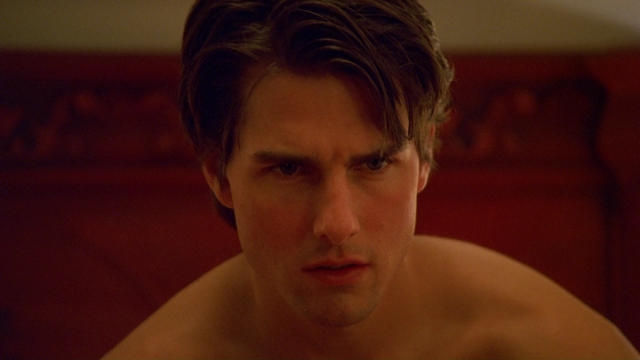
            This is where the fun begins. Alice’s infidelity is based on a thought she had, and one she did not act on. However, as Kubrick brings the camera closer and closer into Bill, the anger on his face slowly registers (very slowly). As the next night continues, and Bill comes closer and closer to his own infidelity, Kubrick intensifies Bill’s vision of Alice and the sailor. He makes it worse in his own mind in order to justify his own actions.

            In similar way, we have to track Bill’s own adventures as a series of more intensified infidelities, even if he rejects them. We start with the widow who wants to cheat on her boyfriend, the prostitute looking for a customer, the daughter of the costume shop owner who hints at a chance at pedophilia, and of course, the secret society that uses sex as a religious catharsis. Much has been tackled about the last of those stops, but it is not possible without seeing each one that precedes it as trying to “top” the situation. Bill needs to assert himself by taking revenge—his manhood is literally put at stake, and the small scene in which the street kids call him a fagot only reinforces the possibilities.

            If Bill fails physically, he does not fail metaphysically. Eyes Wide Shut is all about the thought of doing something, and because the film has us identify with Bill, our thoughts are no less different than his, meaning anything we consider, he certainly considers. So he does commit metaphysical infidelity through the thoughts of the audience. This is Kubrick at his most complex, using the audience as a surrogate for his character. Bill’s own infidelity rest on our shoulders to have thought that he should have sex with one or all of these women, even just for a moment (this is of course is created by the shots and editing that Kubrick so slyly creates).

            There is the side of the reality to Bill’s adventure, which is, even if he see some quite strange stuff, quite tame compared to the dreams of Alice, especially her second dream, in which she has sex with multiple men while Bill watches. Alice’s dream is that most vile infidelity one could imagine, but again, it is only a dream. Bill has created a reality for himself, which is what the second half of the film is about—dealing with the physical repercussions of his attempts at infidelity. Even when he has not actually done anything, Bill is forced to see the actions of what little he has done, or could have done.

            The irony of it all is in the title Eyes Wide Shut. It’s a contradiction. So is the metaphysical aspects of physical lust. Yet Kubrick’s final film has taken on the bold subject, and brought it together in a strange and mysterious way. I have just started to crack open the themes on this film, and there is so much more that I have to understand (to be honest, the entire religious sexual cult is a mystery to me, but I am fascinated by it every time, not for the frank sex, but for the production design and how specific it looks, making me feel that each piece has a specific meaning). We don’t know if there was more to what the film could have been, that may have made it more accepted by those who despise the film. Again, Rossenbaum: “Kubrick recut both 2001 and The Shining after they opened commercially…Undoubtedly, he would have made a few slight adjustments in Eyes Wide Shut had he lived longer” (269-270).

            However, I think Kubrick went out on a film that for him was in a way one that he would have been most proud of, because of the debate. The director’s films are impenetrable by nature, forcing us to dive deep into our own conscious and consider our own morals to understand his view. The film’s eerie lighting throughout feels like a Lynchian nightmare, and which everything is either a little to bright or a little too dark. Kubrick refused to see the world in a straightforward manner—and when the lights finally going off, whether in space, the battlefield, or as in Eyes Wide Shut, the bedroom, that’s when our true emotions are revealed.
A good deal of research for this essay is in debt to the amazing website “Film Studies for Free,” which provided me with not only a copy of the original script but four highly critical examinations of the film, which I read in preparation for writing this. Here are links to the essays here: