Tuesday, September 28, 2010

NYFF Interview: Apichatpong Weerasethakul


Apichatpong Weerasethakul, who goes by “Joe” in the states, is small and a bit quiet, yet extremely friendly when it comes to discussing his movies. He has been considered one of the most prominent film directors of the last decade, and his last two films, Tropical Malady and Syndromes and a Century, appeared on numerous best-of-the-decade lists. Uncle Boonmee Who Can Recall Past Lives, his Palm D’or winning film, cannot be described as a genre, even though if anything, it might be considered a supernatural film. But during the interview at Film Society below, Joe talks about the different aspects of his latest odyssey.

Not that many of us Americans know much about Thailand. But tell us about this part of Thailand. In other movies we’ve seen Bangkok and a little bit of the South, but this part seems quite different in many ways.

It’s the Northeast part, which is where I grew up, and it’s quite harsh. Many go to work in Bangkok or Phouket, so it’s also poor, and there’s a lot of tension.

Is it a place that’s especially known for spirits, and think more about mystical things.

It’s all over the country. It’s all over Thailand. The thing for an audience and Boonmee are the animals really, and it’s more serious.

One of the things in the credits is that you see British companies, German money, French companies, and many different international co-producers. I’m wondering how that aspect and reality in contemporary cinema are really being produced by a variety of international funders.

It hasn’t changed much for my way of working because the people who help have passion for what I do. I feel protected in a way. In the ending scene, there was a different scene. There were  four flashes, and people said this is impossible to show because of people with epilepsy.

You used the Uncle Boonmee character before; will you use him again?

Yea…But this project, which was part of an art project, let me know more about the region and very interested in learning more about this region.

The beginning you talk about the border and the two differences between Thai and Laos immigrants.

In the North region there are very many Laos and Cambodia…there is a lot more immigrants, especially in the 60s when Laos fell apart, and people came into the country…its important for my work, and in this one in particular, because you talk about life and death, and the nature in the region is very important.

In one scene, Boonmee talks about killing communists. Is there a political background we’re missing here?

This area was prone to communist manipulation, starting in the 50s, and very recently and had a widespread of communism and the villagers were really intrigued by this ideology. So with the support of an American company, there was a lot of crackdown, from Vietnam to Laos and to Thailand. People can read about this and its quite brutal but people had no choice but when you were asked “Are you a communist?” and if they said yes they’d be shot on the spot, and if you said no they’d still beat you up. So many decided to escape into the jungle like the monkey ghosts. There was a monk during this time, in the 1970s that was during the student uprisings in Bangkok, and this famous monk came out and said killing communists is not a sin, so this sentiment in the region until on has spread on.

In the West we are told to go toward the light till when we die, but here we go toward the darkness, and the ghost sister says “Heaven isn’t so great,” and there is a lot about reincarnation. What is the Thai sensibility about death?

We believe that death is not the end, and things go on, but for me I would say that I believe that’s a possibility and to wait for it. And when we die we decompose and become parts of the Earth and the grass and we pass on. In the Buddhist system you go through a cycle.

Could you talk about the princess sequence?

In the film there are several tributes…This is like a style of filmmaking that is dying so this princess scene is one of the styles I want to include, which is often on television—these costume dramas on television always involve a princess and often an animal.

Where do you get your actors?

Two of them are my regulars…but Uncle Boonmee is a fictional character, I wanted a non-actor who doesn’t work on other films. He’s a construction worker.

The film ends with dual realities, could you talk about that?

I wanted to suggest more time and more universes, and the world is multi-verse, and so Tong could become a monk. This movie could happen before Syndromes and a Century, which also showed that, so this is a comment and play on time in the movie itself.

Could you talk about the symbolism in the scene in which the princess sexually surrenders herself to that catfish, and what actually goes on there?

I like that, “sexually surrendered.” Remember, it’s a tribute, but she didn’t feel content where she was and she wants to change and transform, again like the monkeys, which is why she surrenders her physical object in the hope to escape. In fact we had that the scene that you have to buy the DVD for where she is pregnant and is worried that its going to be a monster, where its going to be half-fish half-human, and they talk about human, man, nature, and animals.

Are physical relations between man and animals in Thai legends and stories? In Tropical Malady there’s of course the tiger and the young man.

I think its not just contained to Thailand because here or in other cultures as well. In fact, in Tropical Malady, I quote from a Japanese tale in the beginning.

How did the book it’s based on inspire you?


That book was published in a Buddhist temple, and I got it before Tropical Malady, and Uncle Boonmee is mentioned in that film, but I didn’t know how to do it, because of the time jumping, and I was trying to make it like a biography. But I was inspired by the idea of remembrance and that he is always reborn in that region, which was part of the art installation, which was more focused on political situations in one village. In that village people try to forget, but Uncle Boonmee remembers so much.

How did you get the look of the red eyes?

We used just regular lights, and put it through the make up. Just computer controlled LED lights.

Would you say the monkey ghosts are symbolic of rebels or communists?

It can be, but it’s very open for me. It also can be the idea of people when for parents that your kid has to go away, and I think its kind of the projection that Uncle Boonmee is about to die.

Are you inspired by the ideas of science, such as quantum mechanics, that talk about reincarnation?

Yes but I don’t understand it. I’m more inspired by the mystical portion of it. In fact the idea of reincarnation and the idea of time. And I read somewhere that Einstein talked about this and wrote about this.

Could you talk about the dynamic lighting quality, which seems to have a thin gauze or haze over the screen?

Each of my films has a different look, so we shot in different styles. You can see in the dinner scene that it has my usual style and has a certain type of lighting, but the jungle is a really old tribute to old jungle films. It’s a very different look from Tropical Malady because we used a technique called “Day for Night” to achieve this artificiality.

What were you shooting on?

Super 16mm

Have you ever thought about shooting in either other countries or more urban regions?

In fact, yes, I’m planning a portrait of Donna Gucci in Japan.

In the end of the film, Tong has an ambivalent relationship to monkhood. Was that a sly comment on the difficulties you had with Syndromes and a Century and the censor board’s issues with the portrayal of monks?

I cannot deny, there is a little bit about trying to push them, but more importantly, it’s about that time, and about that relationship between what comes first and Syndromes and a Century. Also when my father died in China, I became a monk for a while, and then stopped. H

Who are the filmmakers that inspire you today?

There are so many, but Bruce Baillie, who is an American experimental filmmaker, and Manuel de Oliviera, and the fact that he’s so old, and he still kicks ass. 

Monday, September 27, 2010

NYFF Review: Silent Souls


Silent Souls
Directed By Aleksei Fedorchenko
Russia

            Have you ever heard of the Merjon people of Russia? In Silent Souls, director Aleksei Fedorchenko traces some of the rituals and customs of this ancient Russian tradition, in a narrative that is almost as compelling as the traditions are, which sad to say, does not bode well for both parties.
It’s hard to know if some of these customs—some of them extremely misogynist and offensive—are actual realities, or if Mr. Fedorchenko has taken a very poetic license; They haven’t managed to get a Wikipedia page up yet to explain this all. Of course, the real issue with Silent Souls is that Mr. Fedorchenko wants to tell us about these customs, but never cares to invest a narrative in them as well.
We begin with Aist, a middle-aged and alone Russian man, going to work, in almost a Malick-like fashion of voiceover. And then Miron, he best friend, informs them that his wife is dead, and the two must travel 1,000 miles to perform an ancient ritual. This ritual includes braiding ties to the woman’s pubic hair, rubbing her naked body in vodka, and burning it, while pouring bottle after bottle of vodka onto it.
None of this is really explained well, but Mr. Fedorchenko, who must be a descendant of the tribe, is fascinated by the process, and shoots it accordingly. He finds this all to be a lyrical poem, and his compositions are quite picturesque, if rarely making much sense in the purpose of the narrative, which falls completely behind. We aren’t really given any entry into Aist nor Miron, who travel often in silence, and Aist only uses his narration to explain customs, in the hopes we are less offended by some of the sequences or revelations revealed.
But Mr. Fedorchenko is in love with his symbolism—water, chipping birds, and doubling to name a couple—and thus he forgoes any narrative cohesion for a conclusion that should provoke mocking more than tranquility. On the plus side, Silent Souls runs a brief 75 minutes, so this crash course on why Russians can be offensive people and pass it off as “culture,” comes to an end not a minute too soon. 

Sunday, September 26, 2010

NYFF Review: Of Gods and Men


Of Gods and Men
Directed By Xavier Beauvois
France

            In times of great dire or need, the saying goes, people always turn toward religion, God, or something of a greater power. We desire for some meaning, some understanding, or simply some compassion. Yet in Of Gods and Men, Xavier Beauvois’s film following a brotherhood of monks in the greatest of crisis, the passions on both sides have never been higher. As the terror that surrounds these men becomes more desperate, these men only become stronger in their faith, and we feel revitalized by it, desperate not to grab them and cure their situation, but that they may be at peace when the time comes.
            Few films in this year, or any year, will strike such emotional chords as Of Gods and Men does. Mr. Beauvois, an actor originally but has made a splash with his last few films, takes a no-holds-bar approach to his style, and thrusts straight into this monestary in Northern Algeria in 1996. Political chaos is high in the cities below, as Islamic fighter and terrorists scour the land to rid their country of a foreign presence, and the French army strikes back without sympathy for anyone but themselves. And despite what sounds like a violent and brutal film, Mr. Beauvois instead keeps us focused on the monastic life, the daily rituals.
            And with his quiet compositions, neatly ordered like the monastic life itself, the scenes of the brothers simply chanting, farming, and praying, are among the most compassionate in recent memory. The entire film thus slowly draws its tension from the oncoming turmoil that the monks must face. After a group of terrorists break into their monetary in Christmas Eve, the group faces a decision to stay or leave, which becomes more and more complex with each added element. The group, led by Lambert Wilson (you may remember him as that French guy in the Matrix sequels), prays and prays, while continuing to be assaulted from every side about what to do.
            Mr. Beauvois doesn’t let the decision made easy. The few violent moments he does show, he is not afraid to show the horror in true detail, but never assaults you with it, only letting it linger for a moment in the frame, or barely visible on the side. He skips music cues, save for an important Tchaikovsky number near the end, in order to let you sink into their contemplative world, and focus on the decisions as they tussle with what to do.
            Of Gods and Men has a politics agenda, but not one targeted toward the French government, and not one that attacks the Islamic political factions as well. Instead, it is simply about peace and communication. Mr. Beauvois, more than anything, is a humanist director. He enjoys the quiet moments and finds them transformative, which is why they end up on screen in their almost symmetrical compositions, like a series of paintings beautifully put together. In one harrowing scene, a helicopter, armed with machine guns, hovers just outside the church. The brothers hold onto each other, and chant louder and louder, until their sounds drown out the rumblings outside. If anything, Mr. Beauvois believes in the power of faith, and finds a true story that brings out the best in humanity, by calling for peace through our brotherhood.

Saturday, September 25, 2010

NYFF Review: The Social Network


The Social Network
Directed by David Fincher
United States

            During the day before I saw the premiere of David Fincher’s The Social Network, I ended up not having my phone. I was disconnected from the world: No Internet, no Twitter, no texting, and certainly not Facebook. And on the verge of sounding cliché, I did in fact start to notice the details around me: the sounds of the subway car, the subtle choices in architecture, and the smiles of the people around me. Being disconnected was a way of connecting, and although its become a trite argument against the nerds like myself that write on a computer and rarely make it out into the sun, it’s the driving force behind The Social Network, and the film brilliantly displays that.
            Yet before I jump into a long rant on the joys and wonders of the new David Fincher film, which has been written on earlier (and better) by many other critics, I’d rather focus on my stray observations on the film, which I find more illuminating that a particularly standard review. Yes, it’s a masterpiece—so let’s move on beyond that and find the real choices that make that happen.
            But to basics first: Mr. Fincher, known for films that are much more visually dynamic such as Se7en and Zodiac, directs this film written by West Wing scribe Aaron Sorkin, who has one of the best constructed scripts, scene for scene, put together here. A lot of it isn’t probably true, but I don’t believe we are supposed to see it fact for fact, but as a story of a culture. It’s 2003, and young Mark Zuckerberg (Jesse Eisenberg, outstanding), is a programming student at Harvard. He’s just broke up with his girlfriend (Rooney Mara, soon to be sporting a Dragon Tattoo with Mr. Fincher), and decides to quickly create a scandalous Internet site in retaliation, which gets him some spite as well as attention. Soon enough, Zuckerberg is propositioned with an idea of connecting the students of Harvard together, but decides to take it further. With the help of his best friend Eduardo Saverin (Andrew Garfield) starts thefacebook.com, and it’s an instant hit. But whose idea is it? The film flashes from location to location, as well as through temporal space to a pair of depositions, where people fight Mark not only for his money, but to strip him of his pride. Yet does Mark care about this fight? Or even the money that made him a billionaire?
            The Social Network has been compared to Citizen Kane, The Great Gatsby, and other titanic cultural works that display great obsessive men, yet there are some differences that define Zuckerberg, especially at the mile-a-minute speech Mr. Eisenberg gives him (Mr. Sorkin’s script stands at 160 pages, yet Mr. Fincher squeezes it into a two hour film). Early in the film, Mark discusses the idea of fashion and how it’s changing, always evolving, and thus always lucrative. Its interesting how the film approaches the subject that is under scrutiny, almost like an organism that has been genetically engineered, unsure of how to treat it. Sean Parker (played by Justin Timberlake) tells Mark, “We don’t know what it is except we know its cool.” That statement rings out like a motto of the 2000s, not to have to throw the word “zeitgeist” on this film, as one inevitably must. In the age of the Internet, we don’t understand the objects we have, their meaning, their application, but simply their cultural worth, and understand that means something.             
           Visually, some have commented on Fincher’s restrained style here, yet in many ways, his compositions and editing structure have never been better. After that dire first scene, Mark runs along campus, and we get some of the very few exterior shots of the film—we get the world of Harvard as it stands. As the film continues, we are given no establishing shots and simply interior spaces, as if the universe is slowly folding over, and the disparate spaces that leave people so distant, are closed away. Mr. Fincher’s focus on windows and glass leave that idea hanging, the actual frames that separate us, and how transparent those have become. Instead of giving us space, Mr. Fincher simply cuts between spaces as if he were shooting them in the same room, using simple directorial cues to act as if these spaces blend together. The dark, dreary, and drab lighting scheme, as well as the often-frightening score by Trent Reznor, give this film its alienating atmosphere, in which what matters is not how we connect, but the fact that we connect, and that we’re able to do it as much as we want.
            A very few sequences don’t exactly work. In a strange joke, Mr. Fincher films a crew race in the United Kingdom in extreme high definition, in what reminds me of the classic work of Mr. Sorkin’s attempts at parody (the brutal Charlie Wilson’s War had one as well). Another one, a late sequence between Mr. Garfield and his soon-to-be-ex-girlfriend, spells out the themes and ideas of the film a little too obvious, especially for a film that is so subtle.
            The final shot of The Social Network, showing Mark hitting refresh over and over, is one that grounds the film in its human emotion, which Mr. Eisenberg displays with such reserved audacity. It is quite brutal to see a man who just wants to be recognized by a few individuals, but does so by building an empire. Genius is often led by madness, and as Mr. Fincher and Mr. Sorkin see it, and it’s often an accident led by an emotion more than an idea. The film seems to comment that instead of confronting our issues, society has made it easy for us to instead run behind a veil and assert our fears and desires so passively, without any idea of consequence. Mr. Timberlake screams that “This is our time,” and that emotion reverberates throughout The Social Network, but I think it’s a message of fear for what we can become, more than what we’ve accomplished. 

Thursday, September 23, 2010

NYFF Review: Uncle Boonmee Who Can Recall Past Lives


Uncle Boonmee Who Can Recall Past Lives
Directed By Apichatpong Weerasethakul
Thailand, France, United Kingdom, Germany, and Spain

            By the time a princess does some unspeakable things with a catfish about half way through the latest film by the acclaimed auteur Apichatpong Weerasethakul (he’ll tell you just to call him “Joe”), you are firmly in his absurdist, but slightly calming ground. The Thai filmmaker, known for his striking films Tropical Malady and Syndromes and a Century, has returned to a character who was referenced in Malady, and formed an entire story with monsters, ghosts, doubles, and other strange sights and dialogues. Yet Mr. Weerasethakul is not just putting the grotesque in our face to confound and play with us; there’s a philosophical and political stance behind every moment of his film, and even if it doesn’t work, he’s a fascinating filmmaker.
            The title gives a good explanation of what to expect: Uncle Boonmee, old, with a bady kidney and soon on his way out, starts having visions while out in his countryside home in the Northern part of Thailand. His sister-in-law and son can see them too, and instead of freaking out, they kind of welcome them into their home. This is typical of Mr. Weerasethakul, who acknowledges the absurdity of his film’s narratives. When Boonmee’s deceased son returns as a “Ghost Moneky,” a walking, talking ape with red glowing eyes, Boonmee’s sister-in-law tells him “you’ve let your hair grow out.”
            Those not used to Mr. Weerasethakul’s filmmaking style may find it jarring, or perhaps boring, but both couldn’t be further from the truth. At times he is riveting, such as a long descent into a cavern that feels like a journey through to the afterlife, surrounded in darkness instead of life. Or in a shocking moment, in which characters suddenly see themselves in their old positions, watching an alternate present, and perhaps a nod to Syndromes. Mr. Weerasethakul jumps through stories of immigrations, the troubles of monk life, and yes, the sometimes graphic connection between humans and nature, including the beasts that inhabit them.
            Yet Uncle Boonmee Who Can Recall Past Lives does not solidify anything in a straight interpretation, and finding the visual clues that link sequences together is a fascination as well, such as a moment near the end where bright red lights shine in a restaurant, matching those of the Ghost Monkeys starring from the forest. The film is a little more meandering than Mr. Weerasethakul’s previous films, and seems to jump through ideas and philosophies of death a little too quickly. In fact, if anything, the film is a little too stuffed. Tropical Malady kept everything centered on the relationship between the two men—even if one was a tiger for half of it. But in Uncle Boonmee, Mr. Weerasethakul has no problem diverging into issues of Laotian immigration, or simply showing us how sweet the honey from Thai bees are.
            Mr. Weerasethakul though is not one to waste any moment, except to immerse you in a culture. That culture may include water buffalo, soldiers hanging out with giant apes, and meditations on cinema itself, as all part of what it means to live in the Northern area of Thailand. Uncle Boonmee can bring back the culture through memory, and manifest itself on the screen, which is what Mr. Weerasethakul seems to find fascinating. As the film’s credits end, we hear the production turning off camera, and ending for the day, as someone leaves the camera’s sound recorder on. It’s not a self-reflexive moment for the sake of being clever; it’s a reminder than we too are always watching the past, finding the culture that we’ve left behind, and want to return to by the end, which for Mr. Weerasethakul, is best described as a circle. 

NYFF Review: Poetry


Poetry
Directed By Lee Chang-Dong
South Korea

            As the narrative unfolds Poetry, the latest from South Korean auteur Lee Chang-Dong, it’s hard not to think of Mr. Lee’s contemporary from his native country, Bong Joon-Ho and his film mother. Both films focus on maternal parents (though Mija in Poetry is a grandmother) who are forced to take care of indolent sons, and cover their tracks in terrible crimes. However, while Mr. Bong, adapting from Hitchcock and other sources, spins his camera like a maestro into a wildly comic tale, Mr. Lee is a reserved storyteller, trying to reach something that the title aspires to: poetic cinema.
            And Poetry, in terms of the thematic details and stylistic approach, is very much its own film, and the narrative connections hardly register as this meandering, sometimes extremely poignant, story develops. Mija here is played by Yoon Jeong-hee with a delicate balance of sincerity and fear, as her life begins to crumble, and she searches for answers for truth. Early in the film, Mija learns she has Alzheimer’s, but decides to ignore the facts as she has no one to turn to (and the film only occasionally brings this up, one of its faults). Instead, she focuses on taking a beginning poetry class, hoping to be inspired to write just a single poem. However, when she is forced to collude to cover up a crime of her son, things take an interesting turn.
            When Mr. Lee focuses on the story following Mija’s dealings with these men, he hits on a number of very interesting ideas about both gender issues and class relations through his protagonist. With a reserved camera that prefers a still shot than constant motion, he refuses to let neither him nor Mija judge, only simply staring back in confusion. The poetry scenes, however, are simply not as compelling to watch, and Mija’s search for beauty comes off, as, unfortunately boring. I don’t think Mr. Lee planned it this way, and you can tell his heart is in that part more, as it’s the more transcendental part of the narrative. Yet the material, and Mija herself, aren’t as compelling to watch.
            As the narrative do collide toward the end of the film, things pick up, not in speed or tempo, but it Poetry’s moving beauty. Mr. Lee is a filmmaker who catches little details within his shots, more fascinated with the mundane than the grandiose. And so is Mija when search for her poetry. She cannot understand the cruelty and passivity around her, and is searching for something to put all the pieces together. During her first lesson, her instructor tells her that “poetry is about a search for beauty.” When Mija’s poem is revealed at the end, its beautiful, but its also devastating, and leaves us curious to how a film that began with a morose shot of death, can end with a stunning affirmation of life. 

Saturday, September 18, 2010

Spirits of the Samurai: The Angel of Death in Yojimbo

A small precursor: I am taking a class in Japanese Cinema, and will be writing thoughts about some of the films here as the class progresses. 

I also apologize for the lack of updates, but as summer ends and school begins, what can you do?

      In Akira Kurosawa’s
Yojimbo (1961), the director presents a protagonist that seems to hinge on angelic and supernatural qualities. Kurosawa uses a number of curious visual and scripted clues to allude to this strange quality, which helps fuel the deeper moral question the film suggests by the end.
The character played by Toshiro Mifune, is firstly known as Sanjuro Kuwabatake, but that name seems to be a play on the fields that Sanjuro stares at the moment he says in name, as well as his age. A precursor to the Man With No Name from Sergio Leone’s A Fistful of Dollars (1963), Sanjuro enters the town with no objective, but only as a curious observer. When he learns of the two warring clans, he decides to exploit and kill both. For Stephen Prince in his book The Warrior’s Camera, Sanjuro “has no ethical reason for doing so, no ideal to which he commits” (223).
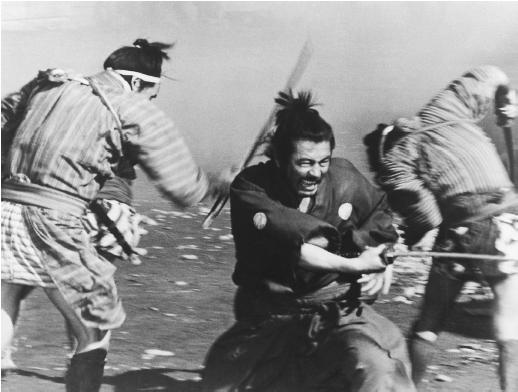
However, Sanjuro is surely fighting for the side of good, even if he is ever so hesitant to reveal such an ideal. The samurai never attacks anyone on purpose, his main fights are when he is being attacked by others and thus defends himself. In fact, he only intervenes in the action twice in the film—to save the kidnapped woman from the men (which someone  suggests would take the power of sixteen men), and during the final battle, when is main objective really is saving Gon, though he does slaughter the remaining bodyguards in the process. Also of note is that Sanjuro kills neither of the lords that are in the feud, only the men who protect them.
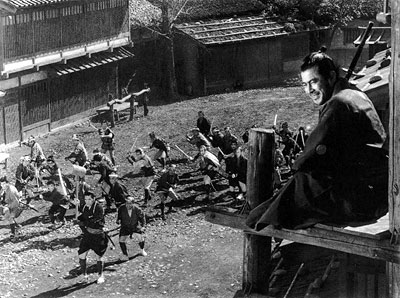
      Sanjuro carries some angelic qualities, and Kurosawa often portrays him as if from another world. Not only does he have no name or past, but also he is emotionally removed. For most of the film, he is reserved and joking, and “amused” by the war between the villagers. The performance by Mifune is also atypical of him, reserving his emotions only for the bloody battle sequences, as compared to his larger-than-life emotions in films like Seven Samurai (1954) and Throne of Blood (1957). Additionally, in one of the film’s most iconic shots, Kurosawa uses a low-angle shot of Sanjuro sitting high atop a perched outlook as the two sides attempt to fight, not only making him emotionally and philosophically above the fight, but literally as well. This is not without mentioning his overall strength compared to every one of the bodyguards in the film, none of which put up much of the fight, except for the nameless gunfighter, who is in many ways also a deity of sorts, not only by his anachronistic weapon, but his entrance in tumultuous weather in which the constable notes how, “even the wind welcomes you.”
      Kurosawa uses the camera in more pointed ways to suggest Sanjuro’s angelic qualities, most notably a gag in which Sanjuro hides in a coffin, suggesting he has already died, and Gon even tells him he looks like he is dead after he has been kidnapped. Donald Richie in The Films of Akira Kurosawa also notes his ability to control the film itself, using the non-diegetic sound. He writes, “When Mifune initially calls on one of the bad leaders he climbs the stairs, slowly. After each step, in the silence between each footfall, there is music. It is like secco reccitaif for the dance” (153). Prince also mentions Sanjuro’s actions directly controlling the narrative of the film, calling him “a kind of surrogate director” (224). In the film’s final shot, Kurosawa continues this suggestion, as Sanjuro literally fades, and as Prince describes it, “Like a shadow flitting across a wall” (231).


     So why make a film about an angelic figure intervening and destroying the lives of humans? One interpretation is to read the film as Sanjuro’s sick joke on Gon, who finally gets the town to be “quiet” in the end. The film certainly fits in with Kurosawa’s other films that deal with ambiguous moral grounds, such as High and Low (1962) and Stray Dog (1949). Kurosawa does not see Sanjuro’s actions as the morally right solution, though he does not propose any other solutions. The town may be quiet, but the path of destruction left only leaves Gon and the few people left to a life of even greater devastation. One could read Sanjuro in a political and historical allegory of the United States “cleaning” Japan, as the images of the destructed town seem to recall photographs of the firebombed villages, but such a reading is too easy and too simplistic for Kurosawa’s intelligence. Instead, Kurosawa has offered up the ultimate morality play about the control of power, and who is allowed to fight battles for others. The ultimate joke seems to be played on Gon. He wants his village to be quiet, a promised that is fulfilled, but the consequences devastating. 

Two Texts were referenced in the above article: