Showing posts with label juliette binoche. Show all posts

Monday, August 20, 2012

Cosmopolis: Day of the Rat


Cosmopolis
Directed By: David Cronenberg
Written By: David Cronenberg, based on the novel by Don DeLillo
Starring: Robert Pattinson, Juliette Binoche, Sarah Gadon, Mathieu Amalric, Jay Baruschel, Samantha Morton, and Paul Giamatti.
Director of Photography: Peter Suschitzky, Editor: Roland Sanders, Production Designer: Arvinder Grewal, Original Music: Howard Shore and Metric

Correction: The article has been updated to reflect a correction in the protagonist's name. It is Eric Packer, not Parker.

            Cosmopolis, the latest and perhaps best film in over twenty years from Canadian director David Cronenberg, begins with an epigraph from a Zbigniew Herbert poem: “a rat became the unit of currency." Herbert’s poem “Report from a Besieged City,” is a strange report from an apocalyptic nightmare. His lines are short and curt in presentation but extremely visual. Are we reaching these apocalyptic times? Perhaps, but not in ways we might be able to see, which is why Cosmopolis, adapted from the Don DeLillo novel, may be the most essential film of the year: an absurdist parable about the influence of technology on capitalism and its effect of the human psyche and body, all which ascribes meaning to the meaninglessness.

            Cosmopolis is a pure intellectual work with perhaps intense philosophical tenants at its core, but its also intensely funny, thrilling, and hypnotizing that it’s a film that can truly be enjoyed as a thrill ride. I was somewhat wary of the film going in—my only experience with DeLillo was his highly acclaimed novel White Noise, where I found his prose more grating and self-satisfactory than anything else. But perhaps removed from my own voice and into the highly controlled voices of Cronenberg’s actors, DeLillo’s words leap from the screen, his complete control of language aware at every moment, making for many laugh out loud moments. Cronenberg’s keen sensibility creates a world full of artifice, one that themes and ideas of his film (his first screenplay in over a decade) and truly expands and builds them on ways that create his own space. To an average viewer, Cosmopolis might look shlocky and almost lazy, but to me, I found every step to be a fascinating commentary on what is surely a film that will shock a select group to their core.

Thursday, January 26, 2012

VIDEO ESSAY — The Double Life of James and Juliette: Mysteries and Perceptions in Kiarostami's Certified Copy


Inspired by the recent wave of video criticism that has taken over blogs like Fandor and Press Play (both essential reading/viewing), I decided to try my own hand in writing, editing, and producing a video essay myself. The first, presented above, tackles my favorite film of 2011, Abbas Kiarostami’s Certified Copy. I hope you enjoy this, as I had a great time making the essay, and hope to do more throughout 2012. Any comments or feedback would be greatly appreciated, either in the comments below or by email.

Friday, March 11, 2011

Certified Copy: Lovers' Game Creates a Platonic Paradox

Certified Copy
Written and Directed By: Abbas Kiarostami
Starring: Juliette Binoche and WIlliam Shimell
Director of Photography: Luca Bigazzi, Editor: Bahman Kiarosami
Rated: Not Rated, but a tame movie with only a few moments of language

            When the Iranian director Abbas Kiarostami last appeared in US cinema screens, his film had about five camera set ups, one location, and mixed somewhere between reality and drama, all which made Ten one of the most brilliant films of the previous decade (He had a few other features and shorts, none which received much attention). Now we have Certified Copy, which stars Juliette Binchoe, is shot in one of the most gorgeous areas of Italy, and Mr. Kiarostami’s camera seems to have a much freer rein around the ara. Has he finally caved in?

            Hardly, or not even a bit. Instead, Mr. Kiarostamihas made something extremely risky and very unique, a mystery film with his strongest narrative to date. Certified Copy is full of gripping emotion, yet at the same time, philosophical ideas as well, giving us lingering questions and shots that can be debated for months. The director may be working outside his home country, but we are really in his playground. Certified Copy is an exploration of perspective more than anything: whose do we see? What are we paying attention to? And does it matter what it represents in the end?

Thursday, September 30, 2010

NYFF Review: Certified Copy

Certified Copy
Directed By Abbas Kiarostami
France/Italy

            When the Iranian director Abbas Kiarostami last appeared at the New York Film Festival, his film had about five camera set ups, one location, and mixed somewhere between reality and drama, all which made Ten one of the most brilliant films of the decade. Now we have Certified Copy, which stars Juliette Binchoe, is shot in one of the most gorgeous areas in Italy, and Mr. Kiarostami moves all and around it. Has he finally caved in?
            Hardly, or not even a bit, though he has made something extremely risky and very unique, a mystery film with his strongest narrative to date and full of gripping emotion, yet at the same time, full of philosophical ideas, lingering questions, and shots that can be debated for months. Mr. Kiarostami may be working outside his home country, but we are really in his playground. Certified Copy is an exploration of perspective more than anything: who’s do we see? What are we paying attention to? And does it matter what it represents in the end?
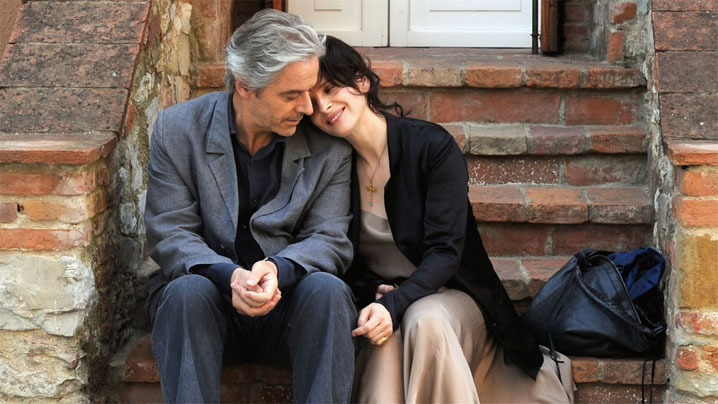
            The film is a sort of a bait and switch; it begins at a lecture in Tuscany, where James Miller, played by British opera singer William Shimell, talks about his book on the nature of copies of precious works of art. In the audience is Elle (Ms. Binoche), who doesn’t seem to listen to his words, but seems to set up a date with him, despite protests by her son. The two take off to a small town in outer Tuscany, where they begin talking about his book, the nature of being smart, and other small things.
            And then the film becomes something different. The two stop playing “getting-to-know-you” and start acting like something else. Or are they acting? And thus Mr. Kiarostami, not one to ever play straight as us, gives us a mystery wrapped in a romantic drama, and keeps us on our heels the entire time. We want to fall into the drama, but he pulls us out every so often. We wonder why we are following these two people, yet listen to their every word.
            Of course, it’s hard not to deny the power of the film when Ms. Binoche and Mr. Shimell are spectacular at their roles. They go through every emotion: excited, happy, curious, angry, frustrated, morose, longing, dire, and more. They keep us invested in a film that I’m not sure Mr. Kiarostami wants us to be invested on in a basic level, as he seems to be aiming for something higher and grander. Ms. Binoche, as always, particularly takes off. When James gives a speech about seeing a mother and child at the statue of David, Ms. Binoche lets out a single tear, that literally launches the entire film from there. Is it a recollection, or a memory? Mr. Kiarostami doesn’t allow us to truly know, but I’m not sure the film would retain its power if it does.
            The beauty of the actors is often put through Mr. Kiarostami’s most scrutinizing directorial vision he’s created. While he is flexible with his camera, he often puts Ms. Binoche front and center, staring right at us, while Mr. Shimmel stares just off to the side. Is she waving at us, telling us we’re being conned? Or is it something real, and should we care?
            In the end, Mr. Kiarostami is asking us to look at the perspectives we bring not only to our vision of art, but to our vision of life. Early in the film, Elle takes David to a small museum that proudly shows off a forged copy of a part of a Roman temple, just because it is as beautiful as the original. In one way, we may scoff at the idea, but Certified Copy is all about what we are seeing when we look. Do we see a woman living a fantasy, or a wife for fifteen years? Do we play along with our stories, or do we recreate ourselves for an illusion that can feel just as real? Mr. Kiarostami, always wanting to play with the illusion of cinema, will always look through the camera and imagine that the whole world is inside that frame, as long as he can.