Showing posts with label pixar. Show all posts

Sunday, June 24, 2012

Screening Log: Ignorance is Bliss Edition


            It’s a short screening log this week, but I’m excited to see Dan Sallitt’s The Unspeakable Act tonight at BAMcinemaFest (as long as my train back to NYC is on time). I briefly met Sallitt a month ago and I’ve considered him one of the most intelligent critics whenever I read it work. Here’s a piece he wrote on Julia Leigh’s The Sleeping Beauty, which is much more eloquent than mine. And here’s a nice Wall Street Journal profile on Sallitt, which also quotes my Personal Recommendation MachineTM Bilge Ebiri.

-Blowup, 1966. Directed by Michelangelo Antonioni. DVD.
-Duck, You Sucker!, 1971. Directed by Sergio Leone. 35mm projection at Film Forum.
-The Ruthless Four, 1968. Directed by Giorgio Capitani. 35mm projection at Film Forum.
-Horrible Bosses, 2010. Directed by Seth Gordon. HBO.  

Saturday, June 23, 2012

Brave: The Greatest Courage Is One of Love

Brave
Directed By: Michael Andrews and Brenda Chapman
Written By: Mark Andrews, Steve Purcell, Brenda Chapman, and Irene Mecchi, from a story by Chapman
Starring: (the voices of) Kelly MacDonald, Emma Thompson, Billy Connolly, and Julie Walters.
Editor: Nicholas C. Smith, Original Music: Patrick Doyle

            For all its fantastic characters, inventive narratives, and ability to make me open tear ducts I wasn’t even aware I had, the most impressive part of the Pixar brand today for me is its seamless ability to truly design visual storytelling. No longer can we watch animation without thinking of the shot structure, editing patterns, and mise-en-scene like the ways we consider in films made without the aid of computers (which, of course, is very few these days). Especially in Pixar’s Brave, their latest film, I found myself constantly tracking the “camera placement,” for something that wasn’t even there. Pixar has continually pushed the mold of what animation can mean, it certainly shows off the company’s ability to use animation not as an end but as a medium, even if Brave isn’t as “groundbreaking” as the company’s previous entries.

            It’s tough when you are Pixar—so many of their films have literally pushed the bar, that when something as solid and well crafted as Brave comes along, the gut reaction is to attack it for not being the equivalent of the Sistine Chapel. What does come up slightly disappointing is that Brave, which has been highly publicized as the first Pixar film to feature a female protagonist, is the film’s rough edges.

Sunday, March 11, 2012

John Carter: Same Hero's Journey, Different Planet


John Carter
Directed By: Andrew Stanton
Written By: Andrew Stanton, Mark Andrews, and Michael Chabon
Starring: Taylor Kitsch, Lynn Collins, Dominic West, Mark Strong, Bryan Cranston, and the voices of Willem Dafoe, Samantha Morton, and Thomas Hayden Chuch
Director of Photography: Dan Mindel, Editor: Eric Zumbrunnen, Production Designer: Nathan Crowley, Original Music: Michael Giacchino
Rated: PG-13 for your standard sci-fi spectacle action.

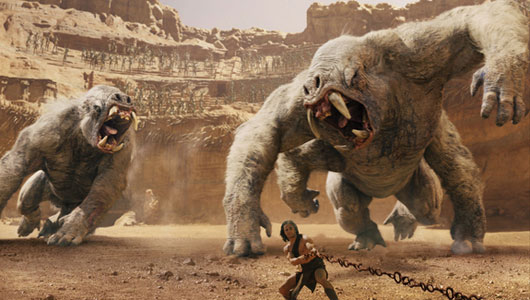
            Have you heard? John Carter is the latest disaster from Disney! It’s an overbloated sci-fi spectacular full of ridiculous characters who have unpronounceable names! It’s overstuffed with CGI that’s there for the sake of more! It cost over $250 million, and if it fails, we’ll never see the likes of it again! Yay, us!

            If you read anything on John Carter this week, which is a very big and costly science fiction epic from Disney, it probably read something like this. And because what the film looks like on its surface, it is certainly easy to pile on the film for representing everything wrong with mainstream filmmaking. Certainly Disney has a trend of these “franchise booter” films since Pirates of the Caribbean, none of which have spawned sequels (see: The Sorcerer’s Apprentice, Prince of Persia, and Tron: Legacy), and John Carter is certainly written with bookends in order to demand sequel territory. But to dismiss John Carter so easily is to dismiss the grounds the film’s director, Pixar alum Andrew Stanton, wants his audience to approach the film. You have to take the drama as intensely as its characters do, and once you give into the power of John Carter, it’s a wild ride on the red desert.

Wednesday, June 29, 2011

Cars 2: From America With a Turbo V8 Engine

Cars 2
Directed By: John Lasseter
Written By: Ben Queen
Starring (The Voices of) Larry the Cable Guy, Owen Wilson, Michael Caine, Emily Mortimer, Eddie Izzard, and John Turturo
Art Director: Jay Shuster, Original Music: Michael Giacchino
Rated: G, though some explosions may frighten the smallest of children.

            There is something unique about the Cars franchise that separates it from almost every other film in Pixar’s history. While Toy Story, Monster’s Inc., and A Bug’s Life among other present mini-universes within our own universe that we just don’t know about, Cars is a world onto its own. There are no humans turned around, unaware that their vehicle is a sentient being (that story is left to Michael Bay). Instead, the Cars live in their own alternate universe, where they eat oil and feel sick when breaking down. Would President Obama show up as a long slick limo?

            Cars and now its sequel, Cars 2, are also known in certain circles with distain as simply cash-cows for the Disney-Pixar brand. While Cars was the least profitable film for the animation giant at the box office, it has also made the most green in toys and merchandising. But such conversations are irrelevant, and make it too easy to attack the Pixar franchise for what is likely to be agreed upon its least successful film to date. John Lasseter, the Pixar founder and current CEO, shows a lot of admiration for the idea of Cars in his directorial style (he passed on directing Toy Story 3 to do this film, after all). And while never as transcendent as Pixar’s other films, Cars 2 zooms its way around a cleverly inspired plot to keep things moving too fast that you won’t mind.

Wednesday, March 09, 2011

Rango: Acting Good, Fighting the Bad and Ugly

Rango
Directed By: Gore Verbinski
Written By: John Logan
Starring: (The Voices Of) Johnny Depp, Ilsa Fisher, Abigail Breslin, Alfred Molina, Bill Nighy, Timothy Olyphant, and Ned Beatty.
Feature Animation: Industrial Light and Magic, Editor: Craig Wood, Production Designer: Mark McCreery, Original Music: Hans Zimmer
Rated: PG, lots of guns, a few explosions, nothing serious.

            Coming into theaters without a Pixar stamp of quality for most animations might create groans for adults, especially those who have children to drag to the theaters. Pixar, with its now 15 plus years of tradition and Google-like innovation, has become synonymous with balancing childhood wonder with serious adult themes. Thankfully, Pixar’s formula is not copyrighted, and other studios and directors are free to try their hand at something a little more adult-friendly. In fact, Rango, a new Western-set animated film, might be way more fun for adults looking for an interesting take on the genre than the kids who may not understand the film's numerous homages.

            Behind the (nonexistent) camera for Rango is director Gore Verbinski. Mr. Verbinski has been a fascinating Hollywood workman, starting off with his creepy and effective work in The Ring, but then falling into directing the increasingly bad Pirates of the Caribbean franchise. Mr. Verbinski though has more talent than those films have shown, and together with screenwriter John Logan (Big Fish), they bring a cornucopia of ideas to this acid Western, mostly through homage and parody.

Friday, June 18, 2010

Defending The Great White Shark

            At the current moment, this year’s most critically acclaimed film, Toy Story 3, sits atop the Rotten Tomatoes chart at 100% fresh, with over 125 reviews. This prompted film critic Roger Ebert to write on his Twitter: “World awaiting Armond White.” He's not the only one—it seems multiple people are waiting for the film critic to give the film a bad review, only so they can pounce on him. But why?

            For those who follow the film critic world, Armond White has a rap that is not exactly the greatest. Mr. White has been called many things, mostly a troll, someone who trashes good movies just to have an opposite opinion, and simply a bad critic. And they do so with good point—he just seems to like really bad movies, and hate the movies everyone else loves. No matter if its an art house film from around the globe, the little indie film that could, or the blockbuster that defies expectations, Mr. White’s reviews for the New York Press will trash it, and trash you for liking it.

            However, is there anything of credit to Mr. White? Sure he goes overboard. Last year he called Precious the most racist film since The Birth of a Nation and earlier this year had to defend comments about wishing that the mother of filmmaker Noah Baumbach had aborted him (when I asked my former professor Nico Baumbach, Noah’s brother, about the situation, he was truly confused why Mr. White had so much against his family).

            Yet one of the most fascinating things is reading classic Armond White reviews—the reviews that jump off the page, no matter if its praise or hate. If anyone has had the pleasure of reading Philip Lopate’s excellent collection American Movie Critics: An Anthology of Silents Until Now, the author and critic himself includes Mr. White along with over a hundred other critics, including the greats like Pauline Kael and James Agee. Mr. Lopate gives us two of Mr. White’s reviews: His carefully languid praise for Spike Lee’s Do the Right Thing and his insightful discomfort with the same director’s Malcolm X.

            Before you trash Mr. White once more, read these reviews. You should read them not because it means that Mr. White’s style hasn’t changed over the years, but because they are great pieces of criticism. In his article on Do the Right Thing, Mr. White connects the dots between the use of the radio, and the filmic style that reflects the radio throughout the film, creating a parallel world of mashes and mixes that collide both in terms of the audio and the visual in well. On Malcolm X, the critic attacks the standard approach Lee takes to the controversial figure, expecting something more brash and distinct that would honor the political leader in a way more appropriate.

            Mr. White is capable of great criticism, and despite what you may think, he does give valid reasons to why he doesn’t like the film. Let’s take a look at one of his most controversial reviews from last year—Pixar’s Up, which managed to garner only five negative reviews, the most notable of them being Mr. White’s (you can read in full here). White begins his review by putting on his flame suit, comparing Pixar to General Motors in its branding of all that is good and pure. Typical, but necessary for what he will set up.

            His first sentence on Up is an excellent thesis: 

“Up’s uninteresting story of an old widower who attaches his home to helium balloons and floats off to Venezuela with an overeager kid in tow follows the same formula as the previous nine Pixar movies.” 

White is going to attack how Pixar has delivered movie after movie by using the same formula. “Blasphemy already!” one may dare. Let’s see: 

“Pixar’s price sticker includes enough saccharine emotion to distract some viewers from being more demanding; they don’t mind the blatant narrative manipulation of a sad old man and lonely little boy.”

Okay, now we’re getting some meat. Is Pixar sentimental? Do they use their emotional strings to pull at our hearts? Pixar’s films, and especially Up, do have the advantage of making us cry. When I told people I saw Up last summer, one of they’re first questions (second actually after, “Great Pixar film or greatest!?”), is “Did you cry?” And it’s true. I cried like a baby, more than any movie I can remember in recent history. In White’s criticism of the film’s most memorable moment, the silent montage, he criticizes as such:

“Even the montage showing Carl’s marriage to childhood sweetheart Ellie (their wedding, companionship, childlessness, then Ellie’s illness and death), is over-sentimentalized. This silent interlude (which first seems to stretch the genre into seriousness) is no more daring than the utterly conventional Wall-E: It concludes with Carl, alone, holding a blue balloon at Ellie’s funeral. Sheesh. A parallel montage of Carl leafing through romantic-couple scrapbook photos is equally sappy—especially when you consider the logic of “Who took those pictures?” Reality is never a Pixar issue. Although Chaplinesque music underscores these maudlin scenes, they’re not emotionally pure like Chaplin; they preen. Critics who forget that movies should be about people defend this reduction of human experience. It’s part of their Pixar-corporate allegiance.”

Let’s piece through this shall we? White is taking issue with the actual construction of the images. There’s nothing wrong with these moments being put to screen for him, but instead it’s the construction of the images to make them to most emotionally manipulative, along with Michael Giacchino's over-the-top score. Pixar is not delivering anything close to real life, but it’s making you think its tackling serious issues in an adult and realist manner. That for him, is the crux of the Pixar problem: he constantly points over the Pixar, despite its approach to dramatic themes, glosses over some larger issues. When Pixar is at its worst, for White, it when its cute: “‘Cute’ is how Pixar oversimplifies the world.”

Now I don’t agree with Mr. White, but its not because he has written a bad review. I disagree on his philosophical approach to Pixar, that Up already has accomplished so much by at least attempting to offer adult themes while packaged in a conventional style. That montage works wonders not because its glossing over but because its trying to capture life as moments, and those moments are constructed. Mr. White’s argument would make Akira Kurosawa’s Throne of Blood, which is heavily constructed on dynamic imagery, a disaster as well.

But don’t call White a bad critic. White approaches films with the cut-throat brashness of Pauline Kael with the dynamic insights of Susan Sontag. He likes films for his own reasons, and when he writes well, he gives insightful points that one forgets, are always subjective. It’s sad sometimes because when White does fit into the mainstream of critical appraisal—he wrote a strongly positive review of The Hurt Locker, and unabashedly loved the new Tilda Swinton film I Am Love—his work goes unnoticed. People forget that Mr. White doesn’t care what you think of the movies. He only cares about what he thinks. So if he decides to trash Toy Story 3, I’ll gladly read his opinion, not because I want to change my own, but because it’ll be an excellent read.