Monday, June 20, 2011

The Trip: Five Course Meal, Hold the Pleasanty

The Trip
Directed By: Michael Winterbottom
Starring: Steve Coogan and Rob Brydon
Director of Photography: Ben Smithard
Rated: Not Rated, but plenty of foul language.

            The Trip is the latest collaboration between director Michael Winterbottom and British comedian Steve Coogan. The duo have been perfect compliments for each other in the past—Mr. Winterbottom has a ironic and meta-textual obseesion with his humor, which Mr. Coogan matches with his under the breath jabs and self-deprecating tone. But it’s always been Mr. Winterbottom that drives the films. 24 Hour Party People would not be as memorable without his strange collision of history and fantasy, and his adaptation of Tristram Shandy perfectly encapsulates the tone of the novel by using a narrative structure similar to a set of Russian dolls.

            And that’s the main difference in The Trip, a mostly improvised comedy starring Mr. Coogan, as well as Rob Brydon, who starred with him in Tristram Shandy. The film’s narrative is paper thin, but Mr. Coogan and Mr. Brydon are natural together that they don’t really care for one, and Mr. Winterbotton has no agenda here but to capture their absurdity. And while The Trip never breaks ground in terms of really exploring these characters, the comedians are so deliciously fun it’s hard not to turn away.

Monday, June 13, 2011

Super 8: Dreams of a Bygone Monster Movie Era

Super 8
Written and Directed By: J.J. Abrams
Starring: Joel Courtney, Elle Fanning, Riley Griffiths, Ryan Lee, Kyle Chandler, Ron Eldard, and Noah Emmerich
Director of Photography: Larry Fong, Editors: Maryann Brandon and Mary Joe Markey, Production Designer: Martin Whist, Original Music: Michael Giacchino
Rated: PG-13 for a scary monster and explosions

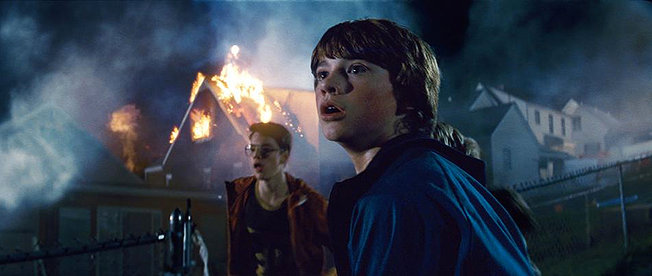
            Growing up anywhere outside of the big metropolis, a child’s imagination can truly grow wild. Mine certainly did, and I spend plenty of days in a sandbox where I would be flying spaceships, searching for hidden treasures, or fighting gigantic monsters. This of course was aided by the films of Steven Spielberg, who knew how to make the fantastic seem rather personal. In films like E.T. and Close Encounters of the Third Kind, the extraordinary was not just spectacle. It was a way to illuminate the ordinary as well.

            It also gave birth to a wave of filmmakers—some who understood his craft, others who just liked the aliens—that wanted to capture that same spirit of ambition, freedom, and innocence. The latest filmmaker to jump into that land is the notorious J.J. Abrams, best known for producing Lost and directing 2009’s reboot of Star Trek. Mr. Abrams certainly has the kinetics of Mr. Spielberg in bringing together spectacular special effects, but the question is does he have a heart as well? With Mr. Spielberg serving as a producer, Super 8 attempts to grab that nostalgic magic of the young ambition of children who see the sky at the only the beginning, and Mr. Abrams has attempted to collide his mystery-box world into that. It’s not an entirely successful film, and won’t sit on the cannon with E.T. or my personal favorite, The Goonies, but it shows a lot more heart than any blockbuster will this summer.

Sunday, June 05, 2011

X-Men: First Class: Back to Basics


X-Men: First Class
Directed By: Matthew Vaughn
Written By: Matthew Vaughn, Ashley Edward Miller, Zack Stentz, and Jane Goldman, from a story by Sheldon Turner and Bryan Singer. Based on the Marvel Comic by Stan Lee and Jack Kirby.
Starring: James McAvoy, Michael Fassbender, Kevin Bacon, Rose Byrne, January Jones, Jennifer Lawrence, Nicholas Hoult, Zoe Kravitz, Lucas Till, and Oliver Platt
Director of Photography: John Mathieson, Editors: Lee Smith and Eddie Hamilton, Production Designer: Chris Seagers, Original Music: Henry Jackman
Rated: PG-13 for comic book violence and a clever use of bad language.

            When it was first announced that 20th Century Fox, in their attempts to continue a franchise, would do another origin story of the X-Men, many alarms went off. Would this be X-Men: Tiny Tykes with a bunch of kids with powers, or would it even be worse, similar to the Hugh Jackman led Wolverine film? X-Men as a series and as a cash cow for Fox plays a difficult balance, as the universe is simply so grand, and finding the right story to tell within that world is often the issue the writers and creators of X-Men face, as opposed to Superman or Batman, where the main character and dichotomy is always in place.

            But besides the apparently badass Wolverine (those claws!), two characters really made the X-Men series the first great comic book film: Charles Xavier, aka the telepathic Professor X, and Erik Lehnsherr, aka the metal controller Magneto. As played by Patrick Stewart and Ian McKellen, watching these two play off each other like Martin Luther King Jr. and Malcolm X became the central core of the film’s first trilogy, with openly gay director Bryan Singer infusing the similarities of gay rights activism toward the comic book franchise, with the appropriate amount of entertaining ass kicking ass well.

Critics on The Tree of Life: Ideas Growing in All Directions


The Tree of Life

This is the second part in my three-part exploration of Terrence Malick’s The Tree of Life. It should be noted that this part does indeed include numerous spoilers. Part I can be read here.

            Since its premiere at the Cannes Film Festival,  Terrence Malick’s The Tree of Life has garnered unique attention by film critics, who have produced some of their most thought provoking writing on any film in some time. In a way, Malick’s film has reaffirmed the need for criticism, as the film, whether a masterpiece or a disaster, is a film that demands interpretation, philosophical musings, and cinematic theories to be explored.

            Less of a look at whether The Tree of Life should be considered a successful work (though that will be explored slightly), I instead have taken a handful of critics who have written thoughtful on the meaning of the film instead. The goal of this is not to come to any sort of a conclusion, but simply expand on some of the different pillars of thought that seem to be towering over other critics as they debate this intensely personal as well as cosmological film.


Film Socialisme: New Cinema; Little Sense

Film Socialisme
Written and Directed by: Jean-Luc Godard
Directors of Photography: Fabrice Aragno and Paul Grivas
Rated: Not Rated, but the only offense is one of comprehensibility.

            When I attended last year’s New York Film Festival public screening of Film Socialisme, Jean-Luc Godard’s latest, and perhaps final statement, on cinema, I counted about fifty walk outs. These people weren’t walking out because the violence was too graphic, or the characters too misogynistic, or its political statements. They walked because of the form. Since 1968, Mr. Godard, director of Breathless, perhaps the most important film in the second half of the medium’s history, has become increasingly more abstract, fighting against normative traditions of not only Hollywood but also all of cinema. A staunch Marxist, who rarely gives interviews (and skipped the film’s Cannes premiere in 2010, providing an ambiguous statement about the political situation in Greece), Mr. Godard has gone from riding the top of the new wave and landed somewhere in land so far that no one is sure where he is.

            Certainly, one can’t even begin to describe Film Socialisme, which has no narrative to even begin to speak of, and instead is a collection of scenes, footage, sounds, ideas, and themes that are simply clashed onto each other. To add to that difficulty, the film’s characters speak mostly in French (though there is some German, Russian, Yiddish, and Arabic), and the subtitles are not translations, but a few chosen words used to represent the possible meaning, or as Mr. Godard has stated, “Navajo English,” a reference to the poor English spoken by Native Americans in Hollywood Westerns (film critic Glen Kenny pointed out they resemble Twitter hashtags).

            Now it would be easy—quite easy—to have joined those walk outs. The film isn’t fun per say, it’s an academic experience, where one must be constantly interpreting image and sound placement in order to create ideas. So when I sat down (pen and paper ready), I took on Mr. Godard’s challenge, to understand what he was trying to say—about politics, cinema, history, philosophy, you name it. To create my enjoyment, I wrote down a number of observations on what was going on, and then looked over those notes to try and create meaning. Film Socialisme is full of academic references that will go over even the most astute viewers’ heads, and thus a full explanation could only be made by Mr. Godard. So in my own “fuck you” to Film Socialisme (as Mr. Godard has no plans on making anyone actually enjoy watching his films), I present THE interpretation of the film. It’s not the right one, but it’s the only one that matters to me, because Mr. Godard has created this film and wants me to respond. So if I am wrong, he can make another film telling me how I am wrong.

Beginners: Coming to Terms With Dad's Coming Out


Beginners
Written and Directed By: Mike Mills
Starring: Ewan McGregor, Christopher Plummer, Melanie Laurent, Goran Vinsijc, and Mary Page Keller
Director of Photography: Kasper Tuxen, Editor: Oliver Bugge Coutte, Production Designer: Shane Valentino, Music: Roger Neill, David Palmer, and Brian Reitzell
Rated: R for a little language and some situations only adults will enjoy

            Beginners, a new film from Mike Mills and starring Ewan McGregor, is in no rush to get anywhere, while jumping all over the place at the time. The film’s narrative zooms back and forth in time, from childhood, to middle age, to a slightly older middle age of its protagonist, the sad but lovable Oliver, but does so in a casual business. This is the same way that Mr. Mills approaches the quirk side to his film—a series of Wes Anderson-styled cutout shots, a dog that talks through subtitles, and a manic pixie dream girl played by Melanie Laurent—but without calling attention to itself.

            What separates Mr. Mills, whose last film Thumbsucker was a bottle of quirk mixed in with teenage angst that came out as a mess, from other quirk directors is the melancholy he brings to Beginners. With its autobiographical touches, the film reaches out with a slight hand to grab you into its narrative, but it never forces you into a world of farce. It instead soothes you into its story of a man essentially trying to find himself and connect to others in the process.

Tuesday After Christmas: Cheating the Holidays


Tuesday After Christmas
Directed By: Radu Muntean
Written By: Alexandru Baciu, Radu Muntean, and Razvan Radulescu
Starring: Mimi Branescu, Maria Popistasu, and Mierela Oprisor
Director of Photography: Tudor Lucaciu, Editor: Alma Cazacu
Rated: Not Rated, but some nudity

            In the latest film from the Romanian New Wave, that ever-prevalent cinema from East Europe that has brought us gem after gem, we get a little morality tale. The story is simple. Paul is middle-aged and living a pretty typical life, except that when we first meet him, he is with a younger woman named Raluca instead of his wife. Director Radu Muntean lets us watch them in their post-coital moments, joking and laughing, with some kisses and physicality, as we see what attracts these people. Instead of giving us their first moment when they locked eyes, or perhaps their intense love-making, we instead see this smaller moment, which plays in real time in a single, maybe 10 minute shot. What Mr. Muntean is able to do is allow us to really understand what drives these two people toward each other, which is what Tuesday After Christmas is all about.

            I had the privilege of seeing Mr. Muntean’s last film, Boogie, a few years back. The film never ran theatrically in the United States, and the version I saw was without subtitles, but it demonstrated another story of a man in a mid-life crisis, and effectively did it through the camera and visual playfulness instead of relying on the dialogue, which I couldn’t understand a single word. Tuesday After Christmas is another work of minimalist genius by the Romanian filmmaker, a taut but often subtle work on the little things that keep us going in our relationships, and how fragile those can be.