Showing posts with label theory. Show all posts

Thursday, August 05, 2010

Inception Continued: Dreaming Reality


Spoilers for Christopher Nolan's Inception Follow

            In what will hopefully be the last words I have to write about Inception (which is false considering my upcoming study on Christopher Nolan’s philosophy as embedded in the final choices and perceived realities of his protagonists), there has been one particular criticism of the film that has slightly baffled me. While I am not the film’s most championed supporter, I find this particular “fault” in the film slightly strange. The argument is best summarized by A.O. Scott in his New York Times review

“But though there is a lot to see in “Inception,” there is nothing that counts as genuine vision. Mr. Nolan’s idea of the mind is too literal, too logical, too rule-bound to allow the full measure of madness — the risk of real confusion, of delirium, of ineffable ambiguity — that this subject requires. The unconscious, as Freud (and Hitchcock, and a lot of other great filmmakers) knew, is a supremely unruly place, a maze of inadmissible desires, scrambled secrets, jokes and fears. If Mr. Nolan can’t quite reach this place, that may be because his access is blocked by the very medium he deploys with such skill.”


“It's all so neatly organized! In other words, not dreamlike at all. Just disappointingly flat, sterile, cold, rational. If a filmmaker is going to dream, the challenge is to dream big, to show us things in ways we haven't seen before, not to simply regurgitate indifferently executed clichés from action pictures and heist movies: car chases, kidnappings, gunfights, interrogations, elevators, ski chases…”

            Both these critics, who are among many, point to the fact that Christopher Nolan gives us a dream world, and the decided to not explore it, something that David Lynch would never do. The dreams, whether inspired or not, are purportedly grounded in something that could exist in the real world. The car chase through LA is cold and dreary, the hotel, at least before the world starts shifting, is plain, and the snow fortress may have an interesting design, but its nothing out of the ordinary. The worst of it is the area called “Limbo,” where apparently all of the universe’s unkempt dream space is stored. When Cobb and Adrianne arrived there, it is quite massive—skyscraper after skyscraper after skyscraper…and that’s about it. No cosmic designs in the sky, nothing floating around, simply a big mound of cement.

            However, I think we need go back to Inception’s own inception, and the starting idea. If we can consider what was the idea that inspired Nolan to make this film, which can be difficult considering how muddled the film is thematically, one idea keeps coming back: how do establish the difference between dreams and reality? I think if we consider that idea, along with what Nolan does with the mise-en-scene of his film, there are some quite radical revelations. Instead of giving us something out of this world, Nolan takes his cues from Michael Mann's often ultra-realistic films, and attempts to show us a dream world that we can believe in. In Inception, the goal of Cobb’s team is to trick the dreamer, and thus the viewer, that they are not dreaming. Which is why the dreams look real.

            Nolan seems to be taking cues from the philosophy of quantum physics: even the most random things are bound by specific rules. Everything in the universe that we know follows logic. So why are dreams so different? Is our subconscious unhinged or do we simply think it is not bound by this universe? Nolan takes these notions by creating what can only be described as “dream logic,” attempting to understand how our dreams could function. He lays on blunt ideas, uses his made-up scientific jargon repeatedly, giving us rule after rule in his dreaming. 

            Thus the look of Inception—the cold, dreary, almost dead-less look, is one of order. If Nolan deserves praise on a thematic level, it is because he goes against the typical rule of how dreams should be. He bounds them to their realistic existence. What I hope Nolan is going for is not the already crackpot notion that our reality may just be a dream, but the opposite, that dreams are simply another for of reality, and thus of existence.

            However, this thematic and philosophical idea, the problem that Scott and Emerson find an issue with, is problematic for its own reasons. The layers of exposition take us away from exploring these notions, and when things should start getting crazy, as dreams “collapse” and the subconscious of different characters collide, Nolan sticks to his rules. He’s not willing to take it to the extreme and sticks to what he knows. This is why Limbo is so disappointing—we know that this world could be anything, where Cobb and Mal had full control of anything they could create, and instead they make a plain metropolis that is as cold and meticulous as anything else in the film.

            Nolan, for all his spectacle, is too rational of a filmmaker. He constrains himself to genre tactics, and his ideas are thus buried and have to be extracted. Cobb explains early in the film to his father,” "It's the chance to build cathedrals, entire cities, things that never existed -- things that couldn't exist in the real world," but Nolan has no interest in what can’t exist, only what can. Nolan thus is so bogged down in his rules that thematically, Inception is either point blank or not really saying much. While I have defended the decision of Nolan to explore the dreamscape as a form of reality, I think that is where the imagination stops and reality begins. 

           I repeat what I said in my original review—the more complicated Nolan's films have becomed, the less thematic relevance has been built in. There is a lot to discuss in Inception ("I swear I saw the totem fall!" or "You didn't see the shot of Cobb and Mal's hands when they were old?"), but none it leads to the same discussions that one would have about films that Nolan is reaching for: say 2001 or Blade Runner. Which is why reality for Nolan is a gift and a curse. He creates something truly original, but then again, we've seen it all before.

Monday, July 12, 2010

How A Lawless Man Became an American: Clint Eastwood at Film Society


Originally Posted at CUArts


There’s a moment in Clint Eastwood’s Gran Torino in which the actor and director finally reveals the chiseled 1972 titular vehicle in the film. Eastwood’s character Walt remarks he put together the lavish muscle car together himself. It’s hard not to think of the car not only as a metaphor for Walt, but for Eastwood himself. Built tough and rough, shiny on the outside and hardened on every edge, full of might and capable of anything on a long winded road, and yet the car seems to be destined for greater things and a larger freedom that seems impossible. Damn that car is American.
Although Clint Eastwood’s career may have begun in Europe, he is one of those actors and directors that truly makes American movies that shout “America” from the first word. And while New York moviegoers might be used to the Film Society at Lincoln Center featuring films from the Chinese Communist era or the Hungarian New Wave, for July, they’re bringing it back home with “The Complete Clint Eastwood,” a retrospective of every single one of his films as an actor and a director.
Eastwood ironically started his career not in America, but on the sun burnt plains of Southern Spain with the Italian director Sergio Leone, creating the now epic Man With No Name Trilogy. While the films are more known today for their dazzling camera work in which Leone builds and creates tension, influencing numerous directors like Quentin Tarantino, its Eastwood’s nameless character that centers the film. His persona is not in the tradition of tough but sensitive guy John Wayne, or even the dark Jimmy Stewart performances from his Anthony Mann Westerns. He has the same presence but his morality is absent. In The Good, The Bad, and The Ugly (July 22nd) a character tells him, “There are two kinds of people in the world, my friend: Those with a rope around the neck, and the people who have the job of doing the cutting.”
That quote rings out the standards in which Eastwood’s films has appeared, in which people are put in ugly positions, and the only way to win is to cheat a little. In the trilogy, Eastwood is not the center of American amorality and greed. Coming more from a tradition of noir heroes, Eastwood says little with his mouth, usually filling it with a cigar instead. His squinted eyes suggest a type of misguided disgust for the dying country around him, a new  breed of American justice, so appropriately seen in For a Few Dollars More (July 15th). While Leone is behind the camera capturing it all, it is Eastwood and his character that seems to suggest this new wave of American-ness, based on a shift in culture that, along with the other rebels of the day like Bonnie and ClydeBenjamin Braddock, andCaptain America, suggest that the standard route to the American dream is dead.
However, of these characters, what happens? Bonnie and Clyde are ambushed. Captain America tells us “we blew it” before getting hit with a shotgun And Benjamin becomes just like his parents. Where does the Man with No Name Go? Because he is not a dreamer like the others, and only out for his small but direct goals, he comes back to America and becomes a hero in Dirty Harry (July 15th). Watching this 1971 Don Siegel classic, it’s impossible to see countless detective films and televisions shows with an amoral cop willing to break the rules to win the day. However, Dirty Harry remains a classic because of how willing he is to break the rules. Just like the Man With No Name, Eastwood works for himself and only himself, but instead of greed, the aim is justice, by any means necessary.
As Eastwood has thus moved from in the actor’s chair to behind it, this idea of ambiguous justice and determination of dreams has continued to mark his career as that of a truly American zeitgeist. Eastwood’s characters, whether it’s Francesca (Meryl Streep)and her dreams of a soul mate in The Bridges of Madison County (July 21st), Frank Morris (Eastwood) and his desire of freedom in Escape from Alcatraz (July 22nd), or Jimmy (Sean Penn) in his search for real justice in Mystic River (July 23rd), are searching for something more than the sum of their lives. This American feeling of the lack of satisfaction with the current system and place of the individual has threaded Eastwood’s long career, and it’s the inherent feelings that have also dominated the personas of his characters, who behind their tough shell exterior, are always stuck in an existential crisis of societal placement. Its tough not to choke up at Eastwood’s Oscar winner Million Dollar Baby (July 25th) when Maggie, played by Hillary Swank, tells Eastwood’s character Frankie, “Don’t let me lie here ’till I can’t hear those people chanting no more.” She’s attempting to be something more than she is—a legend instead of a tragedy. So when Bill Munny returns back to the town at the end of Unforgiven (July 18th and 19th) for revenge, the code of the Western is thrown out in exchange for cold-blooded justice.
Clint Eastwood’s career, which now seems to be dominated by his directorial work, has grounded itself in these specifically American values that are not at the core of society, but developed in the frustrations of the 1960s and the view that American is a flawed country. When the heroes return from Iwo Jima in the flawed Flags of Our Fathers (July 24th and 26th) they know the classical values they have lived upon are a lie, as evidenced by the horror in the humanity of the film’s companion piece Letters From Iwo Jima (July 24th and 26th). Instead, only a new breed of American ideals can evolve, one that breaks society’s laws to recapture justice, and reclaim the idealness of the American truth. So whether its for a little more money, to take down the bad guy, fight to reclaim one’s son, or simply dream of bigger things, Eastwood’s career as both an actor and director has truly ushered in what that 1972 Gran Torino (July 27th) represents: a bold and muscular car for a generation that won’t take kindly to weakness.

Sunday, July 11, 2010

All in the Cut: Editing Emotion in New Wave Style of 'Bonnie and Clyde'


            It’s hard to begin to describe the importance of Bonnie and Clyde, the 1967 American classic from Arthur Penn that, along with films like Easy Rider and The Graduate, launched the American New Wave, helping pioneer a new era of American cinema. The film, staring Warren Beatty and Faye Dunaway, is a frankly sexual and violent picture (often at the same time), and is truly an explosive picture. And it was an explosion in 1967. When Bosley Crowther, the long standing critic for the New York Times, dismissed the picture, he was dismissed from the newspaper. Another critic, praised the film: “Bonnie and Clyde brings into the almost frighteningly public world of movies things that have been feeling and saying and writing about” (Friedman, 179). That critic was Pauline Kael, and that review launched her career.

            I re-watched Bonnie and Clyde at a special presentation at the Rubin Museum of Art in Manhattan, New York. Not having seen the film in years, it felt as fresh and as bold as ever. However, one thing stuck out to me more than anything. No, it wasn’t the aimless plot, modeled off of the French New Wave style that Robert Benton and David Newman had tried to emulate. No, it wasn’t the bold violence and sexuality, and the relationship of Clyde’s need for violence for his own sexuality. Nor was it the subtle political commentary—an examination of violence and endless, unnecessary killings following a tumultuous few years of assassinations and war.

            It was the editing. The brilliant, staccato-like, discontinuous but not unstructured editing that made this movie. The editor on the film, who died earlier this year, was Dede Allen. One of the many great female editors, Allen’s first film was a strange noir from Robert Wise called Odds Against Tomorrow. While the film, which stars Harry Belafonte, is a strange and sometimes silly noir that attempts to comment on race relations, the editing is certainly avant-garde. However, Allen, whose work includes Dog Day Afternoon and Reds, is a director who has said she cuts with her heart.

            Benton and Newman wanted to make a New Wave film—they originally came to both Francios Truffaut and Jean-Luc Godard, who encouraged them but ultimately told them to have an American director. And Penn, certainly a director who did not have as many other successes as his colleagues, is certainly a director with a New Wave style. But what separates Bonnie and Clyde from being completely French is Allen’s editing. In Breathless, Godard cuts anywhere and everywhere. For him, the meaning is the cut itself—a break from the establishment. However, this is not how Allen works. She is cutting at beats, though they aren’t the typical beats of Hollywood pictures. But each time she cuts, she reveals something about the characters that’s not in the dialogue. In one of her most dynamic sequences, watch how she cuts. (Click through for the link)

Newman and Benton don’t need dialogue to describe Clyde’s impotence, it’s all in the visual language. Allen cuts between their reactions, getting closer and closer as they becoming more intimate, and then quickly cutting to a long shot after the embarrassment is realized. This allows Beatty, who is simply bigger and more muscular than Bonnie, to assert his dominance over Bonnie again, who simply lies in bed while he stands. 

            Throughout the film, Allen’s work is evident as she pulls into close-ups and long shots that are atypical, except they help reveal the path of these characters. The film is full of moments like the one above where the shot choice says much more than the dialogue. By the time we get to the final bullet ridden sequence—about 100 shots in a matter of seconds—Allen has earned herself as one of the great editors in film history.

            It’s easy to not pay attention to how editing works—great editing is invisible, only helping you become more invested in the story. Godard tried to turn editing into an idea, and Allen helped turned it back invisible, but the emotions of Bonnie and Clyde—her sexual desire, his aimlessness, Buck’s loyalty—only come through with the sensibilities of Allen, because the script avoids making those judgments. If there is one artist that really launched the New Wave from a passing curiosity to the new Hollywood sensation, it was Dede Allen.  


For more on the launch of the American New Wave, Mark Harris wrote an excellent book called Pictures at a Revolution, which examines the five Best Picture nominees of 1967 and the radical shifts in film history at the time.

Thursday, July 01, 2010

Cheating of the Mind: Parallels of Metaphysical Infidelity in Kubrick's Eyes Wide Shut

"No dream is ever just a dream."

             Much has been written about Eyes Wide Shut since the film’s release in July 1999. The film has polarized critics, fans, film buffs, really everyone who has ever watched the film in its entirety (as it probably should). More than the other works of Stanley Kubrick, which have led to their own debates, Eyes Wide Shut has perhaps created so much diversity of opinion because on top of the film's cryptic narrative, Kubrick's passing before the film's release meant there would never be any interviews in which he could explain, or at least hint at, the meaning of his film.

But on the surface, as all Kubrick films are cryptic puzzles, just waiting for us to explore.

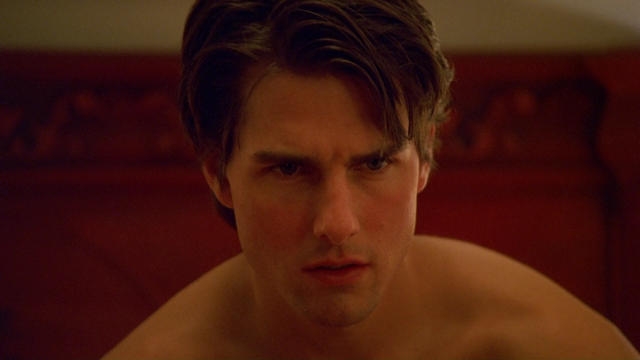
After re-watching Eyes Wide Shut, and reading some material on it, I’m certain on its place as Kubrick’s most daring films in terms of its cinematic elements Unlike Kubrick’s other films, which deal with science fiction, war, or horror, Eyes Wide Shut comforts itself right in the middle of a very human theme: infidelity. But Kubrick makes it about more, specifically the metaphysics of infidelity (bear with me here). Like all of Kubrick’s works, he centers us in this theme through a distancing of the characters, where we are attuned to, but never involved emotionally, in the central relationship. However, the relationship is crucial to the story—we need to believe in the relationship of Bill and Alice (played by then married couple Tom Cruise and Nicole Kidman) in order to take a ride on this story.

            This is not new territory for Kubrick—the attack on Kubrick for lacking sympathy toward his characters has been happening since his earliest films. Jonathan Rossenbaum, in his excellent text Essential Cinema: On the Necessity of Film Canons, writes on Eyes Wide Shut and Kubrick’s work as a whole. He defends, “They’re full of emotions, though most of them are so convoluted and elusive that you have to follow them as if through a maze…He so strongly resists sentimentality that cynicism and derision often seem close at hand” (264-265). Rossenbaum is correct—the only reason we follow Bill’s journey into the night is because we feel that Alice has wronged him, even if it was just telling him a story. Most of Kubrick’s films are about characters driven by emotions, and often the most primal: Lust in A Clockwork Orange, kealousy in Full Metal Jacket, and here, Bill is driven by revenge. The emotions Kubrick pulls with are not as happy-go-lucky as those that his contemporaries could often bring (and a good reason why he turned over A.I. to Steven Spielberg, who bring the sentimentality needed to make the film's metatextual climax even more chilling).

            On the side of the narrative though, Eyes Wide Shut pulls us into its world through its narrative structure, which heads in and out through the rabbit's hole. . As I mentioned before, the film’s theme is metaphysical infidelity, and can be boiled down into one essential question—who has cheated worse, Bill or Alice?

            “But neither has cheated, and Alice did not even leave the home!” you may protest. The film begins at the party, with both Bill and Alice flirts with members of the opposite sex: Bill with the two women, and Alice with the Hungarian. Both are propositioned, but both turn it down, turning to each other at the end of the night. However, when Bill confronts her while the two are high, Alice begins her story about the sailor. One of the simple visual tricks that Kubrick does here is to separate the two actors, never using them in the same frame. In earlier sequences, we often see them together within the frame—close, standing side by side. During Alice’s monologue, she literally pulls away from Bill.

            This is where the fun begins. Alice’s infidelity is based on a thought she had, and one she did not act on. However, as Kubrick brings the camera closer and closer into Bill, the anger on his face slowly registers (very slowly). As the next night continues, and Bill comes closer and closer to his own infidelity, Kubrick intensifies Bill’s vision of Alice and the sailor. He makes it worse in his own mind in order to justify his own actions.

            In similar way, we have to track Bill’s own adventures as a series of more intensified infidelities, even if he rejects them. We start with the widow who wants to cheat on her boyfriend, the prostitute looking for a customer, the daughter of the costume shop owner who hints at a chance at pedophilia, and of course, the secret society that uses sex as a religious catharsis. Much has been tackled about the last of those stops, but it is not possible without seeing each one that precedes it as trying to “top” the situation. Bill needs to assert himself by taking revenge—his manhood is literally put at stake, and the small scene in which the street kids call him a fagot only reinforces the possibilities.

            If Bill fails physically, he does not fail metaphysically. Eyes Wide Shut is all about the thought of doing something, and because the film has us identify with Bill, our thoughts are no less different than his, meaning anything we consider, he certainly considers. So he does commit metaphysical infidelity through the thoughts of the audience. This is Kubrick at his most complex, using the audience as a surrogate for his character. Bill’s own infidelity rest on our shoulders to have thought that he should have sex with one or all of these women, even just for a moment (this is of course is created by the shots and editing that Kubrick so slyly creates).

            There is the side of the reality to Bill’s adventure, which is, even if he see some quite strange stuff, quite tame compared to the dreams of Alice, especially her second dream, in which she has sex with multiple men while Bill watches. Alice’s dream is that most vile infidelity one could imagine, but again, it is only a dream. Bill has created a reality for himself, which is what the second half of the film is about—dealing with the physical repercussions of his attempts at infidelity. Even when he has not actually done anything, Bill is forced to see the actions of what little he has done, or could have done.

            The irony of it all is in the title Eyes Wide Shut. It’s a contradiction. So is the metaphysical aspects of physical lust. Yet Kubrick’s final film has taken on the bold subject, and brought it together in a strange and mysterious way. I have just started to crack open the themes on this film, and there is so much more that I have to understand (to be honest, the entire religious sexual cult is a mystery to me, but I am fascinated by it every time, not for the frank sex, but for the production design and how specific it looks, making me feel that each piece has a specific meaning). We don’t know if there was more to what the film could have been, that may have made it more accepted by those who despise the film. Again, Rossenbaum: “Kubrick recut both 2001 and The Shining after they opened commercially…Undoubtedly, he would have made a few slight adjustments in Eyes Wide Shut had he lived longer” (269-270).

            However, I think Kubrick went out on a film that for him was in a way one that he would have been most proud of, because of the debate. The director’s films are impenetrable by nature, forcing us to dive deep into our own conscious and consider our own morals to understand his view. The film’s eerie lighting throughout feels like a Lynchian nightmare, and which everything is either a little to bright or a little too dark. Kubrick refused to see the world in a straightforward manner—and when the lights finally going off, whether in space, the battlefield, or as in Eyes Wide Shut, the bedroom, that’s when our true emotions are revealed.
A good deal of research for this essay is in debt to the amazing website “Film Studies for Free,” which provided me with not only a copy of the original script but four highly critical examinations of the film, which I read in preparation for writing this. Here are links to the essays here:


Friday, June 18, 2010

Defending The Great White Shark

            At the current moment, this year’s most critically acclaimed film, Toy Story 3, sits atop the Rotten Tomatoes chart at 100% fresh, with over 125 reviews. This prompted film critic Roger Ebert to write on his Twitter: “World awaiting Armond White.” He's not the only one—it seems multiple people are waiting for the film critic to give the film a bad review, only so they can pounce on him. But why?

            For those who follow the film critic world, Armond White has a rap that is not exactly the greatest. Mr. White has been called many things, mostly a troll, someone who trashes good movies just to have an opposite opinion, and simply a bad critic. And they do so with good point—he just seems to like really bad movies, and hate the movies everyone else loves. No matter if its an art house film from around the globe, the little indie film that could, or the blockbuster that defies expectations, Mr. White’s reviews for the New York Press will trash it, and trash you for liking it.

            However, is there anything of credit to Mr. White? Sure he goes overboard. Last year he called Precious the most racist film since The Birth of a Nation and earlier this year had to defend comments about wishing that the mother of filmmaker Noah Baumbach had aborted him (when I asked my former professor Nico Baumbach, Noah’s brother, about the situation, he was truly confused why Mr. White had so much against his family).

            Yet one of the most fascinating things is reading classic Armond White reviews—the reviews that jump off the page, no matter if its praise or hate. If anyone has had the pleasure of reading Philip Lopate’s excellent collection American Movie Critics: An Anthology of Silents Until Now, the author and critic himself includes Mr. White along with over a hundred other critics, including the greats like Pauline Kael and James Agee. Mr. Lopate gives us two of Mr. White’s reviews: His carefully languid praise for Spike Lee’s Do the Right Thing and his insightful discomfort with the same director’s Malcolm X.

            Before you trash Mr. White once more, read these reviews. You should read them not because it means that Mr. White’s style hasn’t changed over the years, but because they are great pieces of criticism. In his article on Do the Right Thing, Mr. White connects the dots between the use of the radio, and the filmic style that reflects the radio throughout the film, creating a parallel world of mashes and mixes that collide both in terms of the audio and the visual in well. On Malcolm X, the critic attacks the standard approach Lee takes to the controversial figure, expecting something more brash and distinct that would honor the political leader in a way more appropriate.

            Mr. White is capable of great criticism, and despite what you may think, he does give valid reasons to why he doesn’t like the film. Let’s take a look at one of his most controversial reviews from last year—Pixar’s Up, which managed to garner only five negative reviews, the most notable of them being Mr. White’s (you can read in full here). White begins his review by putting on his flame suit, comparing Pixar to General Motors in its branding of all that is good and pure. Typical, but necessary for what he will set up.

            His first sentence on Up is an excellent thesis: 

“Up’s uninteresting story of an old widower who attaches his home to helium balloons and floats off to Venezuela with an overeager kid in tow follows the same formula as the previous nine Pixar movies.” 

White is going to attack how Pixar has delivered movie after movie by using the same formula. “Blasphemy already!” one may dare. Let’s see: 

“Pixar’s price sticker includes enough saccharine emotion to distract some viewers from being more demanding; they don’t mind the blatant narrative manipulation of a sad old man and lonely little boy.”

Okay, now we’re getting some meat. Is Pixar sentimental? Do they use their emotional strings to pull at our hearts? Pixar’s films, and especially Up, do have the advantage of making us cry. When I told people I saw Up last summer, one of they’re first questions (second actually after, “Great Pixar film or greatest!?”), is “Did you cry?” And it’s true. I cried like a baby, more than any movie I can remember in recent history. In White’s criticism of the film’s most memorable moment, the silent montage, he criticizes as such:

“Even the montage showing Carl’s marriage to childhood sweetheart Ellie (their wedding, companionship, childlessness, then Ellie’s illness and death), is over-sentimentalized. This silent interlude (which first seems to stretch the genre into seriousness) is no more daring than the utterly conventional Wall-E: It concludes with Carl, alone, holding a blue balloon at Ellie’s funeral. Sheesh. A parallel montage of Carl leafing through romantic-couple scrapbook photos is equally sappy—especially when you consider the logic of “Who took those pictures?” Reality is never a Pixar issue. Although Chaplinesque music underscores these maudlin scenes, they’re not emotionally pure like Chaplin; they preen. Critics who forget that movies should be about people defend this reduction of human experience. It’s part of their Pixar-corporate allegiance.”

Let’s piece through this shall we? White is taking issue with the actual construction of the images. There’s nothing wrong with these moments being put to screen for him, but instead it’s the construction of the images to make them to most emotionally manipulative, along with Michael Giacchino's over-the-top score. Pixar is not delivering anything close to real life, but it’s making you think its tackling serious issues in an adult and realist manner. That for him, is the crux of the Pixar problem: he constantly points over the Pixar, despite its approach to dramatic themes, glosses over some larger issues. When Pixar is at its worst, for White, it when its cute: “‘Cute’ is how Pixar oversimplifies the world.”

Now I don’t agree with Mr. White, but its not because he has written a bad review. I disagree on his philosophical approach to Pixar, that Up already has accomplished so much by at least attempting to offer adult themes while packaged in a conventional style. That montage works wonders not because its glossing over but because its trying to capture life as moments, and those moments are constructed. Mr. White’s argument would make Akira Kurosawa’s Throne of Blood, which is heavily constructed on dynamic imagery, a disaster as well.

But don’t call White a bad critic. White approaches films with the cut-throat brashness of Pauline Kael with the dynamic insights of Susan Sontag. He likes films for his own reasons, and when he writes well, he gives insightful points that one forgets, are always subjective. It’s sad sometimes because when White does fit into the mainstream of critical appraisal—he wrote a strongly positive review of The Hurt Locker, and unabashedly loved the new Tilda Swinton film I Am Love—his work goes unnoticed. People forget that Mr. White doesn’t care what you think of the movies. He only cares about what he thinks. So if he decides to trash Toy Story 3, I’ll gladly read his opinion, not because I want to change my own, but because it’ll be an excellent read. 

Thursday, June 17, 2010

David Mamet and Winter’s Bone: Why Lessons from Hollywood can reign in the Art House


            Last week, I posted my review of the new independent film, Winter’s Bone, which not only has won acclaim from me, but also from critics around the United States (I also posted an interview with director and screenwriter Debra Granik). In my review, I wrote a sentence that may have thrown a few people off: I compared Winter’s Bone to David Mamet in the sense of its screenwriting.

            Now, Ms. Granik’s film doesn’t really feel in the mold of Mr. Mamet, the famed writer and director whose written truly wonderful plays like Buffalo 66 and Speed-the-Plow, as well as some great movies like Glengarry Glen Ross and the surprisingly underrated Spartan.

            What I’m talking about his Mamet’s screenwriting rules, the ones described in his famed book, Bambi Vs. Godzilla On the Nature, Purpose, and Practice of the Movie Business. There’s a lot of material in Mamet’s book, but there is a truly excellent section on screenwriting for all those who are inspired. The best part of the book though comes when Mamet lays down three rules that your film should cover in every single scene:

1. Who wants what from whom?
2. What happens if they don’t get it
3. Why now?

Mamet argues that this is the key to keeping your audience interested and engaged. When the questions are unanswered, your audience is confused to why they are invested in this story. What is the protagonist’s main dilemma? Your audience needs to know. Side plots? Unnecessary unless they will be tied in. Mamet writes, “The film may, perhaps, be likened to a boxer. He is going to have to deal with all the bulk his opponent brings into the ring. Common sense should indicate he had better not bring one extra ounce of flab on him—that all the weight he brings into the right had better be muscle” (71).

This is why Winter’s Bone really floored me in terms of its screenplay. When I often see an art house film, part of that enjoyment is often extraneous. I don’t expect a film by Abbas Kiarostami or Jia Zhangke to even begin to think it should answer these questions in any scene. Hollywood films will answer these questions, but often it’s sloppy, misguided, or simply boring (and worst of all, extraneous). Yet Winter’s Bone does not do this in a single scene. The set up of the film can be answered in the three questions without even thinking.

1.     Who wants what from whom? Ree wants the information on her father’s whereabouts from her meth-cooking community.
2.     What happens if they don’t get it? Ree will lose possession of her home where she takes care of her mother and siblings, and that will most likely be the end of them.
3.     Why now? The cops have come and informed her about the bond on the home which her father has jeopardized because he put it up for his bond.

Almost every scene in this film is built on a variation of these answers. Ree wants information. Her kin have no interest in giving it to her. And she is going to have to fight her way through to get it.

            Winter’s Bone, noir-like but set in the Ozarks of Missouri, is a reminder that your art house film need not be a collection of images and philosophical statements thrown together (though that can be wondrous as well). Winter’s Bone has a hard edge not because of its brutal visual style, but because the script knows how to give and receive information with its audience. It understands that those rules that you learn in Screenwriting 101 aren’t just made to be broken—following them can make your movie more fascinating and much more tense. If we are going to follow characters, these rules get us invested. So when Ree’s hands have to reach into the murky water and she must face her biggest fear, we are right there with her. We'vex These rules have been used in dramatic writing from the beginning. Consider Oedipus Rex:

  1. Who wants what from whom? Oedipus wants the truth of his birth from those around him.
  2. What happens if they don’t get it? The plague will continue to ravage the city.
  3. Why now? A man has accused Oedipus of causing the plague
Mamet’s believes that you can answer these questions for every line, which may be a little ridiculous, but he has a point. Mamet is a tough guy, and writes like a tough guy for tough guys. He hates being extraneous, and the thing that pisses most people off about him is that he is always right. He ends his chapter on the Three Magic Rules this way: “They are, however, part of the unconscious and perpetual understanding of that group who will be judging you and by whose say-so your work will stand or fall: the audience” (86). 

For those in New York, Mamet has a play on Broadway entitled Race that is supposed to be quite good.