Saturday, October 02, 2010

NYFF Interview: Julie Taymor (The Tempest)

For twenty years, Julie Taymor has been known as one of the great visualizers of iconic material. From her theater work, which includes the musical adaptation of The Lion King, to her film work, which includes the acclaimed film Frieda, Ms. Taymor dabs in a color palette that brings electricity to every scene. A huge fan of Shakespeare (she directed the Anthony Hopkins-led Titus), Ms. Taymor brings another adaptation to the screen, this of the Bard’s final work, The Tempest. The film takes a gender change to begin with—Helen Mirren plays the male role of Prospero (now Prospera)—and uses gigantic visual effects to portray Shakespeare’s language. In her interview after a press screening, Ms. Taymor discuses her approach to some of the issues and themes in The Tempest.

Why The Tempest, after Titus, why did you choose this as your next Shakespeare adaptation?

Actually The Tempest was the first Shakespeare play in 1986 with Theater for a New Audience, and I fell in love with the play then, and I directed it three times. And after Titus, in 2000, I decided if I were to do another Shakespeare it would be The Tempest. It’s one of his greats. I had loved it. I fell in love with it in the theater. I don’t think I’d of like to do a Shakespeare film without trying it in a theater first because the paired down minimalism—what you have to do in a theater—you would have to really do it with the actors first. It lends itself to the cinema. It’s extremely visual, and in fact his most visual play.

Having worked on the play several times, what has subsequent readings revealed to you?

One of my favorite scenes is the one where Prospera, in this version, and Ariel talk about compassion and forgiveness. She say, “What do you think spirit? Shall I forgive him?” And he says, “I would if I were human.” And I just find that compelling, both emotionally, and what Shakespeare is saying that all the joy and run of revenge is ultimately about forgiveness and making your way through that.
It’s very different, and in many ways this [film] is saying some of the same things about the play, but my version in the play was a black sand ground with a white site, so the image of the clowns—the fools—was in the original production, in the silhouette. There are many things that haven’t changed, but once Helen Mirren went into the play, without changing the lines, things changed immensely. Not just because she’s a great actress but also because the dynamics were so different. In my stage version, it was a male Prospero, and a female Ariel, although it was just a floating head. Caliban was with a New Guinea mud man mask, and in the film, I didn’t want to hide Ben Whitshaw’s face or Djimon Hounsou’s face, so that brought a different sensibility to those characters as well.

What was your rehearsal process like for the film, in comparison to the stage?

In the theater, you get all your actors on day one, and you get them for five or six weeks before you go into tech. Helen worked on it for four weeks. We did a reading a year in advance because it was extremely critical to both Helen in myself that this wasn’t a gimmick, that is had validity as a Shakespeare play, and it wasn’t about putting a woman in, because obviously you had to change many of the words, the he’s to she’s, the lords to what, the master to what. It’s very interesting because we kept the word master because the word mistress doesn’t mean the same thing. It’s incredible in the English language about what words change and which don’t. We used to word Mum as opposed to mother, and this process of the reading informed us about where we needed to go...
We rehearsed in London with Russell Brand, Felicity Jones, Reeve Carney, and Helen, those actors for about two weeks on and off. And then in Hawaii, where we shot most of the film, I had what we called the court—David Strathairn, Tom Conti, Alan Cumming, and Chris Cooper parts—for not very long, because these actors are very busy. But I did have Djimon, Russell, and Alfred Molina in LA for a hilarious four or five days as well. And we did rehearsals in a bare room where you can really engage with the language and the physicality of it all, before we go to shooting.

In recent years, the character that gets the most scrutiny is Caliban, for obvious reasons. Talk about your conception of that part.

It was very interesting, in my other three production, I had African Americans or Africans play that role. It is a non-white role. If you want to be technical, his father is black and his mother is a blue-eyed hag. He’s just not European in the sense of the world. This play is written in a time in which there were many explorations, many journeys to the New World. He may have been called a monster because he was a Native American, and whatever he was, he was the other. Now, in this version with Djimon, I take Shakespeare at his words, I take him literally. So when he writes, “Thou earth thou speak” or “moon calf,” all these wonderful words to describe, “thou fish thou” I incorporated. He is made of the earth. He is representative of the island because the main theme in this play is nature vs. nurture. And nature, the actual island itself, is Caliban. Is he wrong to have been attracted to Miranda when she comes of age? You watch this conflict in Prospera; she’s a monster at that point for putting Miranda on this island in close proximity with other human beings and its only natural.
It’s about civilization in that sense. So it’s very touchy to put a black man into a slave role, but it felt more honest. It’s not politically correct, whatever that means, but he also has webbed fingers, he’s got a blue eye. He’s got the moon, the two-tone skin that’s he half black, and half white. He’s got this circle—even though that’s not what a moon calf means, I love the idea he looks like a calf, a cow, with these spots. So unlike the theater piece—which I put him in clay as well—he is slightly monstrous in his physical appearance.

How did you conceive of the timing and rhythm for this play for cinema?

Titus was long. It was two hours and forty minutes. And The Tempest is four hours in its full, unedited, unexpurgated version. Now Shakespeare’s plays were never meant to be shown in full, and I had already cut it when I did it years ago to an hour and a half version, and this is probably a little less dialogue and a little longer because I wanted to have certain moments of breathers from the language, but there isn’t a lot. Maybe my feeling is that it is Shakespeare and knowing audience attention spans that I didn’t just allow us to go into these visual massive panoramas—although there are a few—because there is a momentum in the play.
It takes place literally between 2pm and 6pm. It’s interesting because the play is very confusing because she says “Three days hence, I’ll free thee” and at other times she says in three hours. So we played with the idea in time. It was a revelation when I went back to that speech in which she says “I have bedimmed the noon-time sun” and I realized that it was a solar eclipse. So I realized that if I have an eclipse when she starts to do the dark magic on the court, we will be able to go into a theatrical, highly stylized world. It’s very hard to shoot in broad daylight all the time, you can’t control it. And we’re in landscapes where you can’t bring in lighting, we were in cliffs with winds and rain. That’s real stuff. But it was wonderful to pull this sense from the script itself and then bring it to the landscape, and then shoot in green screen or blue screen later on for the highly stylized moments.

Why did you choose to have Beth Gibbons sing the song during the end credits?

That speech, the last speech of Shakespeare’s play, was cut from the film. I never shot it with Helen. I thought we didn’t need it, because she had already done a number of monologues, and what is she going to do, turn to the audience? And even if it hadn’t been end credits, I felt very different. In theater, the house lights come up, the actor unmasks himself, and the artifice is revealed. That really doesn’t happen in cinema.
And then we got to the end of the film, when we were editing, and you had the Ben Whitshaw-Ariel song, and the volcanic glass staff shatters, and I thought two things. One, what are we going to do for end credits, because we don’t have any more money, and on the other hand I thought, its not enough, we need that speech. So [composer] Elliot Goldenthal and I discussed taking that speech and tailoring it a little bit, so a few things are edited from it, and Beth came to mind because she felt like Helen. She has an incredible vulnerability and power simultaneously. The song was written with Beth and mind and we were proud that we could show her the film, and she says yes immediately. Some people have told me they thought it was Helen, but I can tell you, Helen doesn’t sing.

I always thought that it was problematic that Prospero destroyed his magic and gave away his book and I know the speech says “What strength I have is now my own” and that’s the usual interpretation, but clearly the evil is still abound. Sebastian isn’t any better than what he was and neither is the brother. I wonder about your thoughts about this?

I love it because Shakespeare was a realist, and he do these silly things where the bad guys are fully punished and the evil is truly gone. He is so cynical about the world and the most beautiful thing about Shakespeare is that he can be passionate, romantic, and cynical at the same time, and one doesn’t give weight to the other. He can have the most beautiful story about first love, first sight. And think about Ferdinand and Miranda—we talked a lot about the chess game, where she says to him, “You should cheat” and it’s like she already knows what’s in store for her. So what is he saying there? He’s already saying that this youth this innocence is already on its way to corruption.
The character of Prospero and Prospera has done everything in service of the daughter. “I do this for thee my daughter thee my loved one.” I think in this version what we feel really strong about is when Prospero gets his robes back, he just becomes the duke again. But in ours, because it’s a corset, and you go from these androgynous free clothes that you wear on an island and be comfortable, back into that severe female corset, she’s not just giving up her magic, she’s giving up her freedom. So “every third thought will be my grave,” that entire speech is so powerful, as she has that corset tied by Ariel, she goes “So…here I am. So.” And she’s ready to act with these guys.
And we always say, Antonio doesn’t say anything. He doesn’t say anything from the circle of fire to the end, and it’s all in Chris Cooper’s face. This is where cinema is so powerful in a way—I love doing things theatrically but I love doing Shakespeare on film because the acting can fill in the blanks with his or her attitude. The whole ending with Caliban is not the play. It’s unspoken. But the fact that in the end of the play, he/she says “Go into my cave” and he says “Oo I’ll be beaten to death” and he retires into the cave. Since 1986, I’ve felt that isn’t satisfying. I do feel that Prospero or Prospera has made a move, and I feel that Ariel is there to open that. Ariel is the spirit. This I didn’t do in the theater, but that moment where he looks at the staff, and she looks into his eyes, and he looks into her eyes, and she does not lift the staff, which is the only way this white woman is going to have power is through this staff of magic, he walks up those steps and doesn’t look back, and you see what that means in her face. Even when she says, “This thing of darkness I acknowledge thee as mine” that acknowledges that this is her thing of darkness, that she has created this thing of darkness.
What happens is that you can direct these plays 100 times, and you can’t believe what happens. Elliot and I sit there in the editing room or with my editor Francois, and every day we are honored to get something more out of the language, and having actors you get it on so many levels. You get it on the surface level but you also get these riches coming form Shakespeare’s mind.

Click below to read the full interview


NYFF Review: Aurora


Aurora
Directed by Cristi Puiu
Romania/France/Switzerland/Germany

             I counted about three moments where the protagonist of Aurora, played by writer-director himself, seems to be staring back at the camera, almost with a menacing smile on his face. As this three hour epic drags on, Mr. Puiu seems to be mocking his audience. Go on, he dares, walk out on me. Of course, like any good film critic who trusts the director of The Death of Mr. Lazerescu, which was one of the harbingers of the Romanian New Wave, we wait, and wait, and wait for not just for something to happen, but to have something to work with, and have a say in.
            However, Mr. Puiu instead mocks us, almost with more contempt that Lars Von Trier at a press conference. Aurora might be hailed by some as the culmination of what Romanian filmmakers have been getting at with their neo-realistic approach that some have described as “slow cinema,” but its actually a step in the wrong direction, where the style has become as pointless as its narrative.
            Its hard not to think of last year’s Romanian New Wave feature, Police, Adjective, which also featured sequences of its protagonist, walking, waiting, reading, eating, and doing nothing of interest for long amounts of time. But we knew the score even before we got into the narrative—our policeman’s job was pointless, a petty crime that amounted to nothing, and we were thus forced to endure the pointlessness of the protagonist.
            Mr. Puiu gives us nothing. After a brief opening scene, which is completely removed from the rest of the narrative, Aurora then follow the trek of 24 hours where Mr. Puiu seems to walk from area to area, with motivation, but not one revealed to us. The film runs just over three daunting hours, and only after the first hour and a half, we see him obtain a shotgun, our first sign that this is not an ordinary day. And while the sequences where that gun is used are shocking, mainly because Mr. Puiu knows how to make violence hit hard without showing anything, the rest of the film is hard to watch because we have no context for any of this.
            Mr. Puiu is constantly framing his camera looking through doors, in which have the frame is only a blank wall, and we only have access to so much. And thus the film is like that too, where only during the last thirty minutes of the film, do we get some clues, none of which even add up to anything. We are left with no motivation nor consequences, only an action without meaning. Some will sure argue about the brilliance of this—an existential crime in which we fill in our own pieces. Yet the whole procedure just feels pointless.
            “Slow Cinema,” and especially that which the Romanian directors have proved so capable of, is a style that is so effective when used in a narrative that captures us as well, most notably in the 2007 Palm D’Or winner 4 Months, 3 Weeks, and 2 Days. In Aurora, Mr. Puiu thinks that the style itself can serve a purpose, and we can be invested in that. It can’t, and it doesn’t invest us. Had Aurora had a stronger point to make by crafting this minimalist narrative, it could have had much to chew on after the film, making the endurance test worth our time. However, the rewards can hardly be described as paltry, and the film can be said only to truly serve Mr. Puiu’s self amusement. 

Friday, October 01, 2010

NYFF Review: The Tempest

The Tempest
Directed by Julie Taymor
United States


            It’s no lie that if anything is true about her, Julie Taymor loves to create a dynamic palette. Known for her films Frida and Titus, as well as her musical version of The Lion King, Ms. Taymor is a director who knows that the best way to amaze people is by flashing visuals that seem to pop off the screen and the stage. Wow them first, and then they’ll think later. Of course, such a style led to her last film, Across the Universe, a hodgepodge of a film that came close to ruining any sort of name The Beatles have.
            Even so, Ms. Taymor’s work seems a little too big for the New York Film Festival, which prides itself on filmmakers who often have none of her computer graphic trickery, and prefer the suggestive use of the camera to create ideas. Which is why, her newest film, an adaptation of Shakespeare’s final comedy, The Tempest, is a bit of an overreaching explosion for the festival. The film is big, loud, and slightly abrasive, and while it is sometimes magical, its traded in the heart of the play for a big show.
            At least the key difference between other productions of The Tempest and Ms. Taymor’s version strikes an excellent chord. The sorcerer Prospero has been renamed Prospera, and changed genders to be filled by the shoes Helen Mirren. Ms. Mirren is a charismatic actress, and one who knows how to control the screen. Despite wearing costumes that border on the humorous side, Ms. Mirren commands the screen as great her Prospera controls the poor island she rules over. She is a natural Shakespearean actress, a shame when one considers how few Shakespeare roles are available for her without a change. The film thus opens with Prospera conjuring a grand storm upon the ship of the King of Naples, a position that she has the right to, but lost due to a misogynist group of leaders (the only real use of the gender change). Thus, Prospera shipwrecks the motley crew on her island, and we see their adventures, as we as hers.
            The rest of the cast—a surprisingly small one given the grandiosity of the film (mostly Taymor’s visual work)—fills into a mixed bag, which is where natural Shakespeare actors may have been prepared. Ben Whitshaw, still in John Keats mode from Bright Star, plays the spirit Ariel through a number of CGI tricks, mostly distracting more than insightful. Chris Cooper plays Prospera’s treacherous brother, and a companion to the king, played with no energy by David Stratharin. Djimon Hounsou plays the slave Caliban, and Ms. Taymor makes no attempt to clean the blatant Orientalism displayed by Shakespeare (though the visual costume—a series of paints and earthly crust attached to his body—is quite extraordinary. The surprising best part of Ms. Taymor’s The Tempest comes from its drunken comedic side, with Russell Brand and Alfred Molina as bumbling idiots.
            Yet acting isn’t Ms. Taymor’s problem, it’s her love of visual design. Ms. Taymor is more obsessed with what she can show in cinematic form, that she often literalizes the words of Shakespeare, without considering their thematic meaning. The big visuals and rock score are sometimes cheesy, and unfortunately rarely a new take on the ideas more than a big version of it. As the film drags on—despite its short length—it seems Ms. Taymor is more interested in the next effect than the next idea. When all the characters come together in what should be a big climatic showdown, her Prospera’s daughter exclaims the play’s famous lines, “O brave new world, That has such people in’t,” it takes a minute to even begin to feel palatable considering how thinly sketched Ms. Taymor has made these iconic characters. Ms. Taymor has done stage version of The Tempest, and I would have wished to see what she could do without such visuals to fall back on for her magic. The real magic of Shakespeare after all, is in the construction of the words. 

NYFF Review: Carlos


Carlos
Directed by Olivier Assayas
France and Germany

            The name of Carlos the Jackal, the elusive terrorist of the 1970s and 1980s across Europe, spurs images of intense fear, and probably not the soft-rounded body of Édgar Ramírez. Yet just because his body might not look right does not mean Mr. Ramírez does not know how to use such a body, especially when he must command the screen for five and a half hours. The actor, previously seen in small roles in films like Domino and The Bourne Ultimatum, electrifies the screen with his conviction and movement. He  doesn’t just shout Marxist ideology; and throws his entire body, and thus his entire life into his causes. Under the direction of Olivier Assayas, Mr. Ramírez has taken a figure only known by name than reputation, and given him a life force that is at once terrifying yet somehow compassionate and beautiful.
            And thus is the film Carlos, directed by Mr. Assayas, and certainly the most epic production at this year’s festival. Spanning twenty years, ten languages, and at least fifteen countries, Carlos is an ambitious look into a controversial historical figure than is enrapturing and invigorating, and hardly ever dull. Its length is certainly a factor that will dissuade some viewers—the film runs a whooping 319 minutes—but for the most part, the time flies as the film shoots through its mosaic like structure, hoping between moments in Carlos’s life, and trying to find some connection. With plenty of violent action, the film could be mistaken for a big Hollywood production, except the subject manner and Mr. Assayas’s trained camera make it something of a completely different nature.
            The film does open with an explosion though, of a Palestinian supporter in France, and young Carlos, barely twenty and full of revolutionary and violent fervor (He tells us at one point that “behind every bullet is an idea”), is happy to join the International fight for the freedom of the country. Carlos screws up his first mission—and many after that—but he takes pride in his work and his cause. In many ways, this film is about procedure. We see numerous times as Carlos and his allies simply move weapons caches across Europe from the Japanese Red Army to German socialist organizations. Mr. Assayas is clearly interested in the mundane activities that sometimes these men are put through, and watching the negotiations with world leaders and terrorists is simply fascinating, often in a way that amounts to a “not in my backyard” attitude toward Carlos. 
            Of course, when there is action, Mr. Assayas holds no bounds. Having previously done thrillers that subvert action such as Boarding Gate, the director simply jumps in with his close-knit sequences, which are superbly edited together. What is always more fascinating though is the stakes of the sequences, which are simply not about getting from point A to point B. In the middle of the film, Carlos takes the world leaders at the 1975 OPEC meeting hostage, and then is presented with problem after problem on how to turn a bad situation into a good one. We don’t know how this is going to end, and certainly, Assayas does not complicate the sequences with an over-indulgence of bullets and explosions, just straight cinematic tension, both stylistically and ideologically.
            As the film proceeds into its final third (the film is broken into three parts, as it originally played on French television), it is hard to keep up with the more and more frustrating seuqneces, as we watch Carlos thrown around Europe and the Middle East like an unwanted child, a “historical curiosity” as he learns the CIA coins him. But certainly, the film is well constructed, using a series of fade outs, to represent to ongoing struggle day after day to simply exist and make due, an icon who had fallen so low. Yet the fact is, we sympathize with this man. Despite his frightening methods, as we have seen him kill many innocents (in a haunting shot, an agent of Carlos places a suitcase bomb on a train just behind an elderly woman), as well as his Marxist leanings, we feel bad for a man who has worked so hard for so much get so little. Communism falls in Europe, Anwar Sadat is assassinated by Islamists, and nations that supported him fall under the influence of the overpowering West. While I felt the fatigue in that last hour, there was also simply the fatigue that a man who had done so much, after watching procedure after procedure, negotiation after negotiation, come to an end in one of the most pathetic ways possible.
            In the end, Carlos is a daunting film, but one that is truly exciting as well. It’s a cold and calculated film for Mr. Assyass, but its also one that is full of edge-of-your-seat thrills (as well as plenty of steamy, European sex) and bursting with ideas about history. The film never judges the action of the terrorist to be good or bad, but Mr. Assyass is simply astounded with the dedication that a man like this has. It’s a film that might be better on television in which you can watch it at your own pace, but it would be a shame as well, as Mr. Assayas and Mr. Ramírez  simply capture a giant frame like no other, leaving your with a bullet hole through the gut, and highly entertained as well.  

Thursday, September 30, 2010

NYFF Review: Certified Copy

Certified Copy
Directed By Abbas Kiarostami
France/Italy

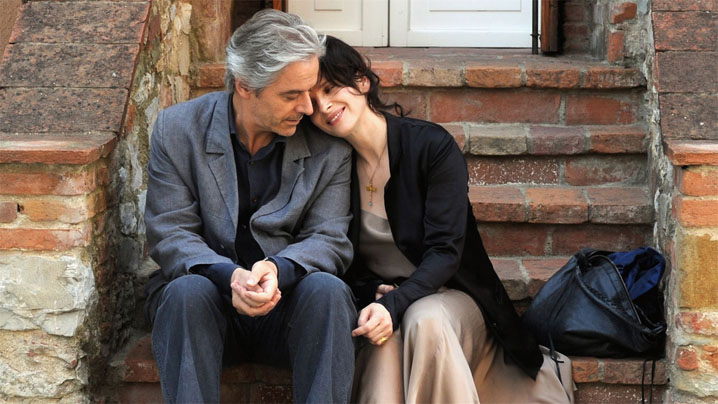
            When the Iranian director Abbas Kiarostami last appeared at the New York Film Festival, his film had about five camera set ups, one location, and mixed somewhere between reality and drama, all which made Ten one of the most brilliant films of the decade. Now we have Certified Copy, which stars Juliette Binchoe, is shot in one of the most gorgeous areas in Italy, and Mr. Kiarostami moves all and around it. Has he finally caved in?
            Hardly, or not even a bit, though he has made something extremely risky and very unique, a mystery film with his strongest narrative to date and full of gripping emotion, yet at the same time, full of philosophical ideas, lingering questions, and shots that can be debated for months. Mr. Kiarostami may be working outside his home country, but we are really in his playground. Certified Copy is an exploration of perspective more than anything: who’s do we see? What are we paying attention to? And does it matter what it represents in the end?
            The film is a sort of a bait and switch; it begins at a lecture in Tuscany, where James Miller, played by British opera singer William Shimell, talks about his book on the nature of copies of precious works of art. In the audience is Elle (Ms. Binoche), who doesn’t seem to listen to his words, but seems to set up a date with him, despite protests by her son. The two take off to a small town in outer Tuscany, where they begin talking about his book, the nature of being smart, and other small things.
            And then the film becomes something different. The two stop playing “getting-to-know-you” and start acting like something else. Or are they acting? And thus Mr. Kiarostami, not one to ever play straight as us, gives us a mystery wrapped in a romantic drama, and keeps us on our heels the entire time. We want to fall into the drama, but he pulls us out every so often. We wonder why we are following these two people, yet listen to their every word.
            Of course, it’s hard not to deny the power of the film when Ms. Binoche and Mr. Shimell are spectacular at their roles. They go through every emotion: excited, happy, curious, angry, frustrated, morose, longing, dire, and more. They keep us invested in a film that I’m not sure Mr. Kiarostami wants us to be invested on in a basic level, as he seems to be aiming for something higher and grander. Ms. Binoche, as always, particularly takes off. When James gives a speech about seeing a mother and child at the statue of David, Ms. Binoche lets out a single tear, that literally launches the entire film from there. Is it a recollection, or a memory? Mr. Kiarostami doesn’t allow us to truly know, but I’m not sure the film would retain its power if it does.
            The beauty of the actors is often put through Mr. Kiarostami’s most scrutinizing directorial vision he’s created. While he is flexible with his camera, he often puts Ms. Binoche front and center, staring right at us, while Mr. Shimmel stares just off to the side. Is she waving at us, telling us we’re being conned? Or is it something real, and should we care?
            In the end, Mr. Kiarostami is asking us to look at the perspectives we bring not only to our vision of art, but to our vision of life. Early in the film, Elle takes David to a small museum that proudly shows off a forged copy of a part of a Roman temple, just because it is as beautiful as the original. In one way, we may scoff at the idea, but Certified Copy is all about what we are seeing when we look. Do we see a woman living a fantasy, or a wife for fifteen years? Do we play along with our stories, or do we recreate ourselves for an illusion that can feel just as real? Mr. Kiarostami, always wanting to play with the illusion of cinema, will always look through the camera and imagine that the whole world is inside that frame, as long as he can.

NYFF Review: Inside Job


Inside Job
Directed by Charles Ferguson
United States

            It’s easy to make a documentary that targets people and makes them into villains, especially when you have a good topic, such as the 2008 financial meltdown. Consider Michael Moore’s Capitalism, which was conveniently released only weeks after the collapse of Lehman Bros, and the real sign of worse things to come. Yet Mr. Moore, for all his earnestness and narrative skill, never really explained what had happened, he just pointed fingers.
            Enter Charles Ferguson, who may be able to compete for one of the smartest scholars alive (he used to be a senior fellow at the Brookings Institute), or at least in his ability to think critically about situations. In his 2007 film, No End in Sight, Mr. Ferguson took on the complicated task of examining how the Iraq War went wrong, and what were the key factors that caused it to go from a peaceful occupation to a war zone. Mr. Ferguson’s findings, which took aim at things that might not seem that bad, showed the key mistakes in an engrossing way, and left his audience simply shaking their heads.
            In his latest film, Inside Job, those heads are about to be boiling in blood. Mr. Ferguson might be a couple years later than most to take on the topic of the 2008 financial meltdown, but he does it with a clarity and genius that few films reach. Rarely pandering to his audience, and keeping us invested in the narrative with interviews with scholars, politicians, bankers, hookers, and everyone who one could possibly need to do about 40 dissertations on the subject, Mr. Ferguson compacts it all into an under-two hour movie, and in a devastating fashion. There are many great films, but this should be required viewing.
            Inside Job neatly divides itself into five acts, like a good Shakespearean tragedy should, and begins in the strangest of all places: Iceland. A brief prologue basically shows what happens when things become deregulated (hint: they are bad, and especially for Iceland). The prologue serves as a reminder for the rest of the film—deregulation leads to more dangerous activity, and those activities become more and more ludicrous until the people actually paying for the mistakes are not the ones that caused it.
            Some of the materials, for those who have read a dozen articles or listened to an NPR story, are a little redundant. Of course, those who haven’t will be shocked at out ridiculous the system is. However, there are also some other truths that I did not know about that really pissed me off. One involves credit rating agencies, which determine which stocks, mortgages, and other credit-backed securities, are safe buys, and how their “opinions” shaped our financial future. The one that certainly gets the most blood though involves professors at top business schools, such as Harvard and Columbia University. Mr. Ferguson basically depicts how these top economics were paid by banks to write positive articles so they could continue and expand their deregulatory practices. When confronted, the professors respond with anger, bafflement, and embarrassment.
            One should note—Mr. Ferguson is not interested in current political bickering, and neither Inside Job nor No End in Sight blame a specific party for their alignment. In fact, the cold truth at the heart of Inside Job is that both parties, for the last 30 years, have continued to play into the game controlled by the major financial companies, and there seems to be little hope in the current administration, and no promise in the recently passed financial regulatory bill.
            Inside Job ends on the note that some how, these top bankers need to go the jail. It’s a note that seems a little difficult to say the least, but the journey there is simply baffling. Mr. Ferguson jumps from interview to interview without ever losing us. It’s sometimes darkly funny, but mostly just immensely raging. This is the type of film that reaffirms that things are not going to be okay, and that this is not the end. It is only the beginning. Mr. Ferguson sublimely shows that muckraking isn’t a mundanely banal approach, especially when you come backed with more evidence than one would ever need. This is a shot right into the heart, and truly from a non-filmmaking point (though the craft of the film doesn’t hurt either), the must see film of the year. 

NYFF Interview: Xavier Beauvois (Of Gods and Men)

Xavier Beauvois

Xavier Beauvois is a stern filmmaker, and highly outspoken when it comes to politics. Both an actor, and now a director by trade, his film Of Gods and Men has been one of the highlights of the New York Film Festival, a truly moving picture that approaches an extremely difficult subject with grace, civility, and care. Below, along with his co-screenwriter Etienne Comar, Mr. Beauvois discusses his idea process and his politics in making such a film.

When I saw the film I was first surprised that in the 1990s there were communities of French religious living in Algeria. I thought that would have ended much sooner. Could you talk a little bit about the continuity of those communities, and was this one in particular a very unique community, or one of the last ones left?

Beauvois: There are still a lot of these types of communities for example in Morocco. The last survivor, Jean-Pierre, is at the monetary there. Also for example there is one in the Sinai, which the location is a mosque, but it is an old one. There are many such communities, but there are many where they are no religious. For example, doctors, entomologists, and others work in Afghanistan, who are there to help the people and who are martyrs as well, because they end of getting killed.

Could you talk about how you put together the screenplay? Especially with the daily life of the monks—what they did on a day-to-day basis. Were there records? Did you talk to people?

Comar: There were actually quite a lot of things written about this. For example, many of the brothers in the film kept journals that they wrote in every day, including Christian, who you see writing in the film. Also, because in 2006 was the ten year anniversary, there was a lot of things published articles just describing what they’re lives were like. So there was a good amount of information about this. Also, once we started shooting, there was a lot of work that we had to do. So we visited other monasteries to see what their life is like so we could have a practical picture.

Beauvois: Also I did take a few liberties. For example, where the actual monastery was located there were a lot of fruit and vegetable gardens and orchids, and where we shot just wasn’t the case. So what we did was transpose the idea of the gardens and the fruit into honey. So honey became the replacement for it.

There’s an extraordinary sequence with Swan Lake playing, and you have the cutting between all the faces. Could you talk about how you conceived of that sequence?


Beauvois: In the first version of the script, my idea was to have a long scene together where they were perhaps doing the dishes and singing. But then I thought, this might not be very interesting because they’ve been singing throughout the film and also because these are non-professional singers it might not be that interesting. Then I hit on the idea of listening to music instead, and I was listening to a lot of music through my headphones, and I came upon this excerpt from Tchaikovsky’s Swan Lake and I suddenly had this idea in my head. I suddenly saw the whole scene and started to cry and then I couldn’t show anyone I was crying, but this was my idea that it was the music. In French, there is a play on words; the word for director where part of the word is also the word for the Last Supper. So I had this idea where Christian as Jesus with the disciples around him. It was a challenge but it just came so vividly to mind.

There’s a bit of dialogue early in the film about girls who are unveiled on the bus. This film is set in the mid-90s in Algeria, but it has a very contemporary feel with the questions of veiling in France. Was that an accurate depiction of what was going on in Algeria at that moment?

Beauvois: Actually no the whole question of girls wearing headscarves had already begun around that time, but this of course is something that is really big right now. In France, they are trying to make people as afraid as possible, so the issue now has become the burka, which covers the head entirely, and it sort of has these phantoms in cinema. The actual number of women—who wear the burka—are probably 0.00001%, maybe 500 women in all of France. And yet this very small percentage of women has really come to monopolize the French press. Perhaps 50% of the French press is devoted to this issue, and what it really is, is an attempt by the Sarkozy government to divert people’s attention from what the real problems are, which are problems surrounding poverty, about people not having enough for their retirement, about suicides over economic troubles, so its really a way of diverting their attention, since it affects such a small number of people.

Comar: In 1993 through 1996 there were many, many killings, about 170 Algerians, Imams, intellectuals, people in the street, religious, so all the stories are larger than what is going on in this film.
Etienne Comar

Beauvois: You’ve had countries like France where girls are fighting to wear headscarves and insisting they be able to do it, where you have other countries where people are fighting not to wear them, or all traditional Islamic wear for women. And in both cases these women can be Algerian but they could be women in Algerian, or Algerian women in France, and its almost surreal, because of this episode…Just to imagine if one day, President Obama declared that people who get dressed up like Batman and try and scare children should be banned. Then you’d get an idea what this would be like.

Going back to the use of Swan Lake, which happens to be not a religious piece, but specifically a secular piece…

Beauvois: Actually music for me is very important I listen to it all the time, for example Sergio Leone and a lot of composers who’s music is used in films. But for myself in using it for my own films, I find it more problematic. For example in my previous film The Young Lieutenant, there was no music at all. What I don’t like about using music in films is I don’t want to cue the viewer when to laugh, when to cry, not to emphasize it by having music. So in this film, there really isn’t any music other than this Tchaikovsky episode, other than the religious music, which is part of their daily lives in the monastery. I think that its significant that the last music that you hear is secular music, and it was important to me because this movie is about men and gods, and perhaps this was the closet they could come to be gods, but they were also just men…I think when you think about it during great moments in life, like great moments of sadness, you are out in the street, there’s no soundtrack behind you. Same thing for kids. They’re on top of the world, and they’re screaming, and there’s no music behind them either.

The scene where the monks links arms when the helicopter is overhead is quite powerful. Was it something you got from the journals or was it something invented?

Comar: It was something completely invented by Xavier but at this time, in the monastery, there were many army operations in the area, because this area was very dangerous, and there was a lot of terrorist threats. So the helicopter was coming some time and very close to the monastery, and some jeeps and some tanks. So we expressed the idea of what was happening there in the scene. But it wasn’t something that they wrote, or was told, it was simply invented.

Beauvois: I always have a very hard time answering where these ideas come from because once you start developing a story and becoming part of a story and filming a story there are a lot of things happening where its not just the story itself. It’s the feelings that are connected with it, the odors that are connected with it. All of these things serve to bring ideas into my head. Sometimes the ideas are symbolic of whatever I’m thinking about and showing. Or some of them are to summarize the things that I have. But it’s a very bizarre thing to tell you exactly where these ideas come from. But one thing I wanted to tell you about having the helicopter over the monastery is that there are many theories about how the monks were actually killed in the end, and one of them is that it was a mistake by the Algerian army, and they were killed by a helicopter attack on the terrorists. So I thought it was good to have this helicopter over them, with the machine guns, and they’re a constant presence over them. So I wanted to hint at that to be present, but I’m not particularly promoting any one theory about what happened, but also I like the idea of trying to show that by linking arms and singing, by song, it’s the contrast by the machines of war that are represented by the machine guns on the helicopter.

One of the great challenges to make a film like this is to create a community of men who are true believers, who believe in something, and that belief fills them and really guides their life. How do you create that belief that is really fundamental to the film?

Beauvois: Actually, if you think about it before you have belief, before you have faith, you have freedom, you have equality, you have brotherhood. Liberté, égalité, fraternité is the motto in France, and what we have here are men who are free men. They are free men who see themselves as being equal to each other, but also brothers as religious brothers, but also with the Muslim people. So these are basically humans. Unfortunately, what we now have in France is a situation where people are a little less free and a little less equal and a little less fraternal. And I think that the important message is that this is really a question of intelligence. These are really people who speak with each other, they question each other, they’re interested in each other and they approach if from that angle rather than one of proselytizing one faith over another. Frankly, I could never really make the film if it was about proselytizing with these missionaries; that was not the case with these men….Actually, an incident happened to us yesterday. We were walking around the city and we saw a Jewish family—the father was wearing a yamaka and was with his wife and child—and they crossed paths with an Arab family—the woman was wearing a veil—and they knew each other and were saying, “Oh hi how are you?” We really stopped and looked at this because this is the message of what my film is, but its not something you would see in France.

What do you see as the message of your film? About hope, about religion, and about reconciliation?

Beauvois: Well first of all, this is a film, and I would hope that it could make some sort of impact, but first of all, it was made as a film, and what happens after, once its on the screen, and we can fantasize what we want. I don’t know what this would correspond to, but we had one million tickets sold in 15 days in France, which is an enormous success. And I think why its had this success in France is people have a need for this kind of reconciliation. I think people have had enough of ego building, and bling bling, and Sarkozy-ism that’s been prevalent up to now. And perhaps its this desire to return to things that are more simple, and I don’t want to be pretentious, but perhaps I hope that my film will encourage people to talk to each other and perhaps have an atmosphere that is less fearful. Schindler’s List was a film that really changed things because a lot of people didn’t know what was had happened during that time and I hope this film can do something similar.

Comar: There’s also something that I’ve been surprised by since we started the project together is the fact that in 1996 when this drama appears, this question between Muslims and Christians was not really spoken even in France. There wasn’t a lot of press about this crime, and how they died etc. But during the anniversary in 2006, it was ten years after that, and we were in the post-2000 years, which is a very different world, and there were a lot of stuff about the fact that what they were saying in 1996 makes it feel like now. They were saying things out of peace, a lot of Ghandi, and Martin Luther King. So this message was quite relevant in the film.